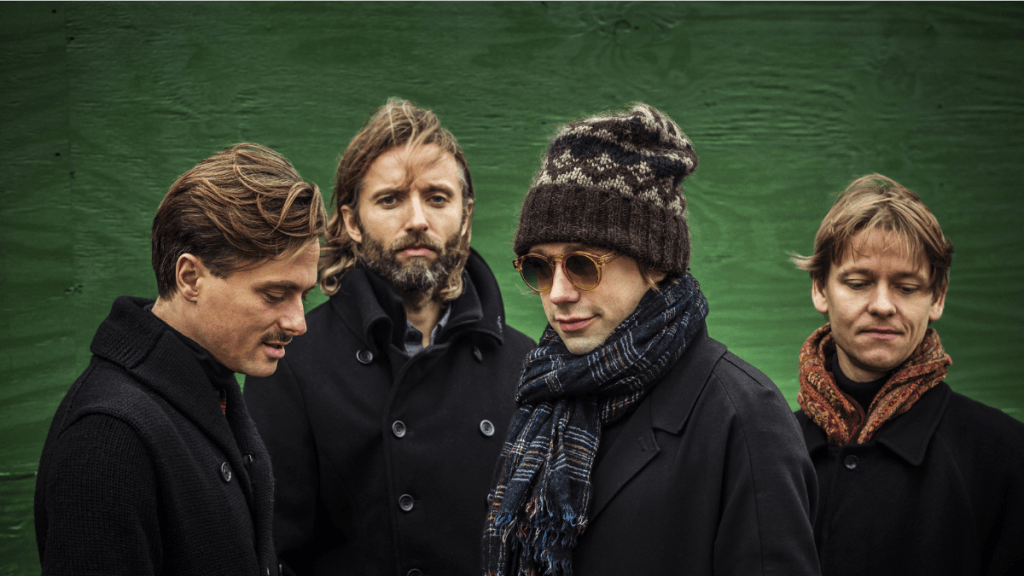
When Mew’s third album, Frengers, landed on my desk in 2003, I was instantly hooked on the Danish act’s unique art-rock sound. In the years since, Mew has become one of my favourite bands of all time. With the band’s future uncertain—a run of “farewell” concerts has been announced, but there is talk afoot that Mew will actually continue without frontman Jonas Bjerre—it seemed like a good time to revisit some of the times I have had the opportunity to interview various members of the band over the years.
Perfect Frengers: Denmark’s Mew might just conquer North America with its alien but strangely uplifting sound (2007)
This article originally appeared in The Georgia Straight.
To much of the band’s newfound North American audience, Mew probably seems to have materialized out of nowhere. Certainly, the group’s sound is otherworldly, with its sweeping synths and angels-on-high harmonies grounded by a rock-solid, sometimes downright punishing rhythm section. The fact that most listeners in this part of the world heard Mew for the first time only when its most recent album, And the Glass Handed Kites, got its U.S. release last summer adds to the impression that the group beamed in from some parallel dimension with its breathtakingly original music fully formed.
The truth is that Mew came together in its native Denmark almost 12 years ago. Over the course of four albums, the Hellerup-spawned band has risen from indie-underdog status to the pinnacle of its home country’s music scene, scooping four prizes at last year’s Danish Music Awards. It must feel strange, then, to go from being the most popular rock act at home to being a cult act on foreign soil. Reached at a tour stop in Boston, drummer Silas Graae insists that his veteran group doesn’t mind having to build its overseas audience from the ground up. “I think that’s a more healthy way to do it, somehow: gradually and slowly,” he says. “We’re very privileged and lucky. It always seems to be growing, and that’s good for us.”
Speaking of luck, Mew’s Canadian fans have been slightly more blessed than its stateside ones: And the Glass Handed Kites was released here a full nine months before it came out in the U.S., and it was the second Mew disc we got to hear, the first being 2003’s Frengers. In fact, Frengers didn’t come out in the States until January of this year, after a nation of Pitchfork readers started drooling for it. This puts Mew in the unlikely position of having to tour behind an album that isn’t its most recent effort.
“We like that record as well,” Graae says matter-of-factly. “We don’t dislike that record or can’t stand playing its songs, so it’s great to come and support it.”
Frengers is indeed a worthy listen—certainly one of the top releases of ’03—but Glass Handed Kites is Mew’s masterpiece. Just about everything is perfect, from the anthemlike refrain and end-of-all-things guitar blitzkrieg of “Apocalypso” to the impossibly uplifting intertwined vocal harmonies that close “Zookeeper’s Boy”. Singer Jonas Bjerre possesses the voice of an androgynous alien, capable of the sort of heart-rending flights that leave sensitive types with tear-streaked faces. This is in marked contrast to the grainy croak of slacker-rock icon J. Mascis, who lends his voice to two tracks, “Why Are You Looking Grave?” and “An Envoy to the Open Fields”.
The latter selection makes it clear that this is a band with a taste for the grandiose; the song bursts to life in a Technicolor explosion of sky-splitting dream pop before settling back into a simple beat. Well, it seems simple, until you try tapping your foot to it and realize that the time signature keeps changing right when you think you’ve finally got it figured out.
It’s a testament to Graae’s skill and subtlety as a drummer that such touches, which are all over Mew’s songs, don’t smack of audacity or self-indulgence. “It shouldn’t take up too much attention to be making strange [time] signatures,” he says. “It’s much more about the whole thing than just one thing.”
Not that Mew is a wholly populist undertaking. A Scandinavian prog-pop act with a flair for the melodramatic and a girlie-voiced pixie for a frontman is perhaps not everyone’s cup of Tuborg. Mind you, the fact that all of Bjerre’s lyrics are in English at least leaves the door open—a mere crack, perhaps—to the possibility of a massive international following. Hey, it worked for Aqua, sort of.
“I think for Jonas, it comes more natural for him to sing in English, somehow,” Graae says. “Why, I don’t know. He just seems to be more comfortable in that language.” The global dominance of American television might have something to do with it, but perhaps not as much as the music that the members of Mew grew up with, such as My Bloody Valentine, the Pixies, Nirvana, Sonic Youth, Dinosaur Jr., and the Afghan Whigs—English speakers all.
In any case, familiarity with the lyrics lets the front-row punters sing along when Mew is on the road. The band is currently touring North America as a headliner for the first time. (Vancouver fans still speak reverently of the group’s jaw-dropping but all-too-brief set a few months back, when it came town as Kasabian’s opening act.) After that, the conquering Danes will finally get a chance to work on something new.
“When we are not travelling and not playing shows, and we are at home, we write,” Graae notes. “We’ll go back to Denmark and start where we came from, with the new material. That’s the plan. And maybe we’ll come back and do a tour later, if someone wants us over here.”
I have a feeling someone might.
Mew explores space on No More Stories (2009)
This article originally appeared in The Georgia Straight.
Let’s get the full title of the latest Mew album out of the way right off the bat. It’s called No More Stories Are Told Today I’m Sorry They Washed Away No More Stories the World Is Grey I’m Tired Let’s Wash Away. It takes a while to say (and type), but that seems apt, since the music that the album contains is worthy of spending some quality time with. The Danish band’s fifth full-length release, No More Stories is rich in sonic detail, with the group reaching beyond its signature brand of epic art-rock to explore moody synthesizer-based pop (on “Tricks of the Trade”) and songs driven by insistent marimba motifs (“Hawaii” and “Vaccine”).
Reached in Washington, D.C., where Mew is preparing to open for the Pixies at DAR Constitution Hall, singer Jonas Bjerre says that he and his bandmates, guitarist Bo Madsen and drummer Silas Graae, took deliberate steps to open up their sound. For Bjerre, that meant largely relieving himself of six-string duties. “I always really just played rhythm guitar, or I did, like, inverted chords and stuff like that, but I never really had any virtuosity with my playing,” he admits. “And I thought it was better to leave room for Bo, because he’s a really unique guitarist, and he has completely his own style that he keeps developing. So there’s more room for that. And he doesn’t play as many power chords and stuff like that on this record. So I would say it’s more spacious. It has room for a lot of mallet instruments and percussion and things that we usually don’t use as much.”
Another major change is the absence of founding bassist Johan Wohlert, who left the band after the release of And the Glass Handed Kites, the 2005 album that brought Mew to the attention of North American music fans. Bjerre says Wohlert’s departure accounts for the new disc’s dearth of burly rockers, such as live favourites “Snow Brigade” and “Apocalypso”.
“A lot of the rock stuff that we used to have was based on Johan and Bo playing up against each other with bass and guitar, and the grooves came a lot from Johan and Silas playing together,” Bjerre notes. “And now, Silas and Bo are developing the rhythm sections, and it’s based around chord progressions, but not in the same way as it used to be. I think we really explored, because we were a little bit tired of doing things the same way. We definitely needed to expand our horizons in the department of writing songs, and methods of writing songs. We tried out a lot of different things, and the songs actually came together in lots of different ways on this record.”
When most bands talk of expanding their songwriting horizons, that might mean trying out some new effects pedals or experimenting with alternate guitar tunings. In Bjerre’s case, it meant creating a song in a way that no one else ever has. The appropriately titled “New Terrain”, which kicks off No More Stories, is actually two tracks in one; play it in reverse and it’s a separate song called “Nervous”, with its own set of lyrics.
“I wanted to make something that could be sort of a palindrome song,” Bjerre says. “We were kind of playing around with palindromes. And obviously it’s not a palindrome, because the lyrics are different, but I just wanted the lyrics to be somewhat audible in reverse as well as forward-playing. And so I was just playing around with these words and these melodies, and kept reversing it until I had something that worked on the piano, and melodically and lyrically worked. Then we took it into the practice space and added the beats, and Bo kind of developed the chord structure with a baritone guitar, so it kind of grew from that. But it was meant to be something that could be played backwards from the beginning.”
Lyrically, “Nervous” (which is available on the vinyl edition of No More Stories) seems to make more sense than “New Terrain”. The former is apparently about paranoia (“It seems everywhere you go/They’re out to get you”), but the latter is more opaque: “Like most, you snip soft sheets/What’s this about.” Indeed, what’s it about? Bjerre’s not telling.
“If you go to art academy or something like that, you’re taught to always be ready to explain yourself,” he says. “And to me, that’s not really that interesting, because I don’t work like that. I don’t have a ready answer to any question about any of my lyrics. I just like to go with things and see where they take me, because I’m not a very analytical person. I just like the experience of things, and feeling them and shaping them. I don’t necessarily like to talk about them at great length or write essays about them or anything like that, you know?”
Good idea. Save the essay-writing for the album titles.
Returning bassist made Mew more of a band (2015)
This article originally appeared in The Georgia Straight.
There’s something to be said for making an artistically ambitious album. There’s also something to be said for actually being able to play your own songs on-stage. Danish art-rock outfit Mew discovered that these two things can be tricky to balance when it came time to hit the road in support of its loftily titled 2009 LP, No More Stories Are Told Today I’m Sorry They Washed Away No More Stories the World Is Grey I’m Tired Let’s Wash Away. (The album is, thank God, usually referred to as simply No More Stories by band and fans alike.)
Recording for the first time without the grounding influence of bassist Johan Wohlert, the group’s remaining members explored what singer Jonas Bjerre, reached at home in Copenhagen, calls “clouds of ideas that came together in a weird way”.
Bjerre says the resulting album is among his favourites in the Mew catalogue, but he also notes that the long-running act had no intention of ever making No More Stories II. To help avoid that, the band called on Michael Beinhorn, producer of 2005’s And the Glass-Handed Kites. His solution? Get Wohlert back onboard.
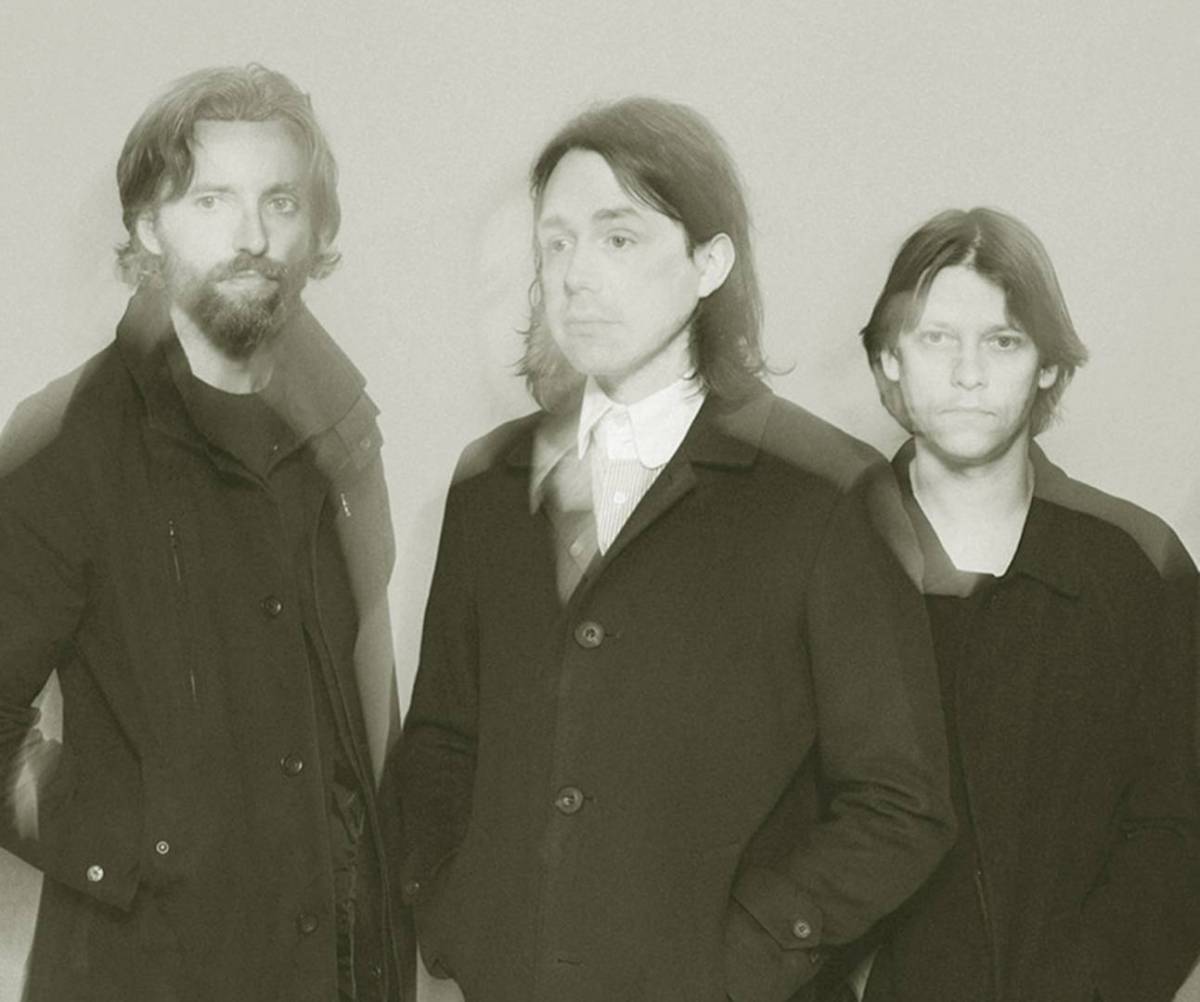
“We needed something to happen, and Michael was missing the feeling of the rhythm section with Silas [Graae, Mew’s drummer] and Johan,” Bjerre says. “The last record he’d done with us was the Kites record, which had Johan on it. So he said, ‘Why don’t you just give him a call and invite him in to do some writing sessions at first?’ I said, ‘Yeah, sure.’ We’d actually talked about that over the years, doing some writing together. Then when he came in, it was actually surprisingly fast. It felt like he’d never left. It felt like he’d only been gone for a couple of months instead of seven years. So that was really thrilling and gratifying to experience.”
The latest Mew record, the Beinhorn-produced + –, doesn’t tone down the group’s taste for the grandiose—check out the almost 11-minute dream-pop epic “Rows” for proof—but it does bring its more visceral, urgent elements to the forefront. “My Complications”, with its churning rock attack, is as close to “back to basics” as Mew will likely ever get.
“It sounds more like a band playing, to me, whereas No More Stories, a lot of it sounded like production things,” Bjerre admits. “Some of the songs on No More Stories, we haven’t even really played live, I think. Some of them only a few times, because they just didn’t really translate to the live setting that well. So that was one of the things Michael wanted as well on this one. He said, ‘You guys have to play the songs in the practice space, and they have to sound complete before we go in the studio. Before we start adding stuff to it, it should work just as songs you’re playing. That’s the greatest starting point you can have.’ So we worked really hard on that, and the songs translate really well to the live scene, I think.”
Local fans will get to judge that for themselves this week, but those counting on seeing Bo Madsen are in for a surprise. Apparently needing a break from the road, the guitarist has taken an indefinite hiatus from the band he helped form more than 20 years ago. For this tour, his parts will be played by Mads Wegner. And in the future? Will Bjerre himself end up playing more six-string to fill the void?
“We’ve been listening to some demos on the tour bus and enjoying talking about the future and what we’re gonna do, but it’s still a little unsure what’s going to happen, exactly, so we’ll have to wait and see,” the singer says. “But, yeah, I love playing guitar. But I’m more of a rhythm guitar player, I’m not like a lead guitar player. I don’t know. We’ll see what happens. I’m sure we’ll think of something!”
Danish band Mew makes the most of life as a trio (2017)
This article originally appeared in The Georgia Straight.
The art-rock gods giveth, and the art-rock gods taketh away. In 2015, veteran Danish band Mew gave fans several reasons to rejoice. The first was +-, its first album in six years. The second was the return of the quartet’s original lineup, with bassist Johan Wohlert rejoining after a nine-year hiatus.
Now comes the “taketh away” part: after completing work on +-, founding guitarist Bo Madsen announced that he was leaving. Once again, the mighty Copenhagen foursome became a trio. Mew’s latest LP, Visuals, is the first to feature none of Madsen’s signature six-string work, which has always been light on blazing solos but heavy on slippery rhythms and unexpected phrasing.
“The initial writing and recording was very much like we’ve always done it, pretty much, regardless of whether I was out of the band or Bo was out of the band or whatever,” says Wohlert when the Straight reaches him on a day off in Boston. “It felt very similar, but obviously with any group of people, if you remove one element it’s going to sound different. I think that’s one of the main reasons that we were able to take the band in yet another direction, or at least try out new things.”
Throughout a career spanning over two decades, Mew has forged a unique aesthetic based on Jonas Bjerre’s stratospheric vocals and the canny interplay between Madsen, Wohlert, and drummer Silas Utke Graae Jørgensen. The group has flirted with everything from dreamy indie rock to the sort of mind-bending prog that other musicians love to geek out over.
Visuals isn’t a major departure for Mew, although Madsen’s absence is palpable on “85 Videos”, a shimmering modern-pop concoction that wouldn’t sound out of place on an M83 record. (A good M83 record, that is. Not necessarily Junk.)
There are guitars on Visuals, of course, notably the grunge-caked riff that opens “Candy Pieces All Smeared Out” and the quirky jangle of “Twist Quest”. According to Wohlert, many of the six-string sounds come courtesy of Mads Wegner, who has been Mew’s touring guitarist since Madsen’s departure.
“It was mostly Mads,” the bassist confirms. “We wanted him to do it because a fresh outside perspective is good, and technically he’s a way, way better guitar player than me and Jonas. Also, you invest a little more of yourself if you’re a part of the record-making process, and it reflects in your relationship with the material when you go out on the road afterwards.”
His contributions notwithstanding, Wegner is not officially a member of Mew. Nor, for that matter, is keyboardist-guitarist Nick Watts, who has been touring with Mew since 2001 and has played on several of the group’s LPs.
“With a band like us, you have to understand that we’ve been going at it for 20-something years,” Wohlert says. “The band was me, Jonas, Silas, and Bo. And whenever somebody leaves, that doesn’t mean that you can get somebody in to take their place. It just means that you get somebody in to play shows. That just feels natural, and that’s how we prefer it, to be honest. It’s just the three of us now, and that’s cool.”
 John Lucas
Leave a comment