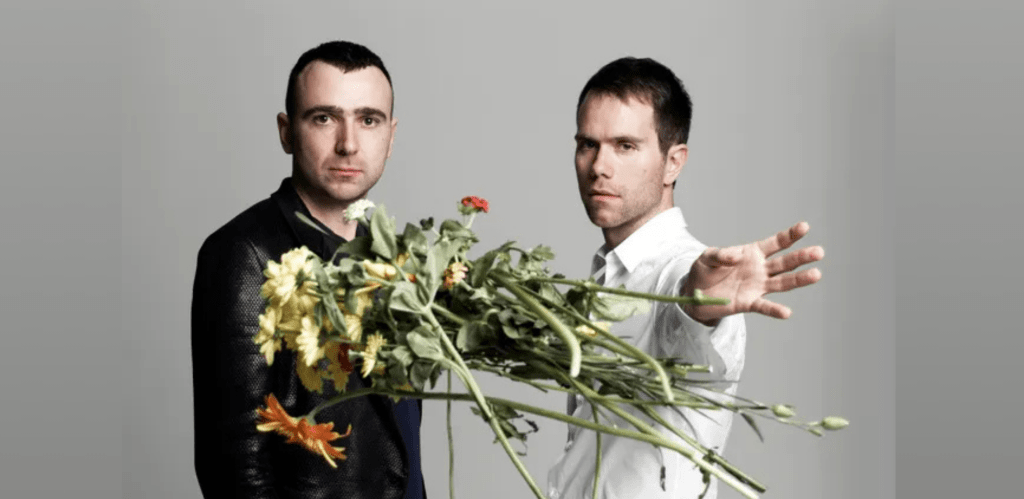
On this day in 2009, the Georgia Straight published my interview with Kim Moyes of the Australian electronica duo the Presets. Moyes had a few choice words for the Smashing Pumpkins’ Billy Corgan, who he desribed as “a sour Sally”, among other choice epithets.
The Presets are burning up Down Under
(This article was originally published in the Georgia Straight.)
For the benefit of those who stopped paying attention to Billy Corgan a decade ago, the shiny-headed singer-guitarist is actively looking for someone to fill the recently vacated drum stool of the glorified solo act he still pigheadedly insists on calling the Smashing Pumpkins. That news probably has a lot of stickmen salivating, but Kim Moyes isn’t among them. The drummer and keyboardist for Australian electronica duo the Presets says that after an incident that occurred last March, he has little use for Corgan, whom he describes as “a miserable prick”.
At the V Festival on Australia’s Gold Coast, the Smashing Pumpkins and the Presets performed simultaneously on separate stages. Corgan moaned that the Sydney-based pair’s thunderous dance beats were distracting (“I can barely hear myself think with that kick drum in my head,” he can be heard complaining on a YouTube video), but Moyes figures the once-mighty Pumpkin king had other reasons to be peeved.
“He was just pissed off because we had bigger crowds than him, and they were having more fun than his crowd,” Moyes says, reached during a sound check at Washington, D.C.’s 9:30 Club. “And also, I guess he’s just sad generally, and a miserable cunt. So, it’s not a feud. He kind of got the shits because we were playing and it was going really well, and he wanted to play an acoustic number. And it happened to be at the peak of our set. He’s the one who started throwing shit on us, telling his crowd to go and bash our crowd and stuff, and then went and complained to the promoter of the festival. I couldn’t give a fuck about him. I used to like the Smashing Pumpkins, you know? I mean, I don’t know him personally or anything like that, and I certainly have never spoken to him, but he just sounds like a sour Sally to me.”
Well, if there’s one thing a Presets show could do without, it’s a wet blanket like old Uncle Fester. With storm-the-nightclub singles such as the throbbing fuzz-disco stomper “Are You the One?” and the droid-factory funk number “Yippiyo-Ay”, Moyes and singer-keyboardist Julian Hamilton have established themselves as the go-to guys for guilty-pleasure dance tracks. The duo is still building a buzz on these shores, but has taken its sassy blend of rock, techno, and industrial-lite to the top of the charts Down Under. The Presets took home plenty of hardware from the 2008 Australian Recording Industry Association Music Awards, including album-of-the-year honours for Apocalypso, the band’s most recent release. The pair was also named best group, and its song “My People”—which sounds a little like the Rapture being tasered by Trent Reznor—won single of the year.
Bona fide stars in Sydney, the Presets pack stadiums on their home turf but have yet to graduate from the club circuit in North America. Moyes insists it’s all the same to him, noting that the dimensions of the venue and the scale of the audience have no bearing on how he and Hamilton play.
“We still try to bring a pretty full, high-octane energy to the performance, no matter what the size, I think,” Moyes says. “We want to give everybody the same experience at any show, so we just do our one dumb thing.”
In order to perform live as a two-piece, Moyes and Hamilton rely heavily on recorded material, which is a modus operandi that the drummer admits leaves little room for spontaneity. “We have a backing track that we play along with that’s got, like, bass and some synths on it and stuff, and then I’ll play drums live and Julian sings and plays other keyboards live, and there’s a little bit of samples in there,” Moyes says. “We build a live set with the tunes, and we sort of blend the tunes in with each other, almost like a DJ set. It takes about a month to build the backing for every live set, and rehearsing and whatever. When we take it on the road there’s not really any variation. We can only drop songs, we can’t really change the order of the songs or anything like that.”
In other words, the Presets won’t be taking requests at their sold-out Commodore show on Monday, so all you smart-asses can keep your pleas for “Cherub Rock” or “Bullet With Butterfly Wings” to yourselves.
IN + OUT
Kim Moyes sounds off on the things enquiring minds want to know.
On the upside of playing scaled-down venues: “When you play in a smaller club or whatever, sometimes you can have the crowd really close to you, and even over you, and it can be so fun because the energy is, like, inches away and you really feel quite interactive with it.”
On the Presets’ level of fame in Australia: “If people see us at a bar or something, they can get quite annoying and yell at us and go, ‘Oh my God, you don’t understand how much it means to me.’ I don’t know. We’re popular. I don’t know how to say it without sounding like a wanker.”
On whether or not he would try out for the Smashing Pumpkins: “Oh, yeah, for sure. I really get along with Billy Corgan, so I think that would be a perfect match.”







 John Lucas