
Long-running Vancouver indie-rock juggernaut Mother Mother released its 10th album, Nostalgia, earlier this month. With the group spending its summer touring across Europe, it seemed timely to revisit my past interviews with frontman Ryan Guldemond (and the occasional bandmate). Digging through the archives, I discovered that I have actually written about Mother Mother quite a lot over the years, so I have decided to split this blog post into two installments. Here’s the first.
Local motion: mother mother takes heart (2008)
This article originally appeared in The Georgia Straight.
Ryan Guldemond is a dropout, and he doesn’t care who knows it. The Mother Mother singer-guitarist abandoned his study of jazz and composition at Vancouver Community College when he figured he’d taken from it all he needed.
“I dropped out just before I was supposed to complete my diploma,” says Guldemond, interviewed at the Georgia Straight office. “This band started to become too consuming. And it seemed like my whole motivation to go to music school was, of course, to get better at the craft, but also to meet people and become affiliated with some sort of music scene in Vancouver, because before that I didn’t really know how one was supposed to do that—apart from answering ads in the Georgia Straight. Which I did.”
If you’ve guessed by now that Guldemond isn’t a born-and-bred Vancouverite, you’re right. The 25-year-old grew up on Quadra Island but moved to the mainland at 19 in pursuit of a girl who wound up breaking his heart. He stuck around and, in 2005, he started a band, recruiting his sister Molly and friend Debra-Jean Creelman as covocalists. The three initially played in town as an acoustic trio called Mother. Eventually they would add more members and double the act’s name—today Mother Mother also includes bassist Jeremy Page and drummer Ali Siadat.
Two years ago, Mother Mother got a significant break when the brass from Toronto’s Last Gang Records (Metric, Crystal Castles) caught the band’s set at a high-profile festival and decided on the spot to offer a four-album contract.
“They saw us at Pop Montreal 2006 and struck up a deal,” Guldemond recalls. “It seemed pretty hasty on their part. I mean, it was nice. There was very little reservation. And it was kind of the only thing going on, so we jumped on it, too. And so far, so good.”
The first fruits of Mother Mother’s Last Gang contract are a re-release of the group’s 2005 indie debut, Mother (since retitled Touch Up), and the new album O My Heart, which came out in September. Produced by Guldemond and Howard Redekopp, the disc showcases a polished alt-pop sound bristling with ingeniously quirky arrangements, metaphor-laden lyrics, and the quintet’s secret weapon: lush, multipart male-female harmonies. Those harmonies, along with Guldemond’s idiosyncratic vocal phrasing, have led more than one critic to invoke the name of the Pixies. It’s a fair comparison, if not always an accurate one. Sure, the broken-face intensity of “O My Heart” (see the video below) and the pumping bass line of “Body of Years” would have fit on Doolittle like missing puzzle pieces. Mother Mother rarely sticks to the loud-soft-loud template that Black Francis and company laid out more than 20 years ago, though, often fleshing things out with strings and keyboards.
To his credit, Guldemond isn’t disingenuous enough to deny that he spent much of his youth studying the Boston band’s catalogue as if it held the key to the very meaning of life. He is wary, however, of hewing too close to anyone else’s formula.
“Definitely a direct influence in the formative days,” he says of the Pixies. “Grew up with them. Definitely still love them. To me, that’s a good band to be likened to. Could be a lot worse, and, in my eyes, it couldn’t get any better.
“I mean, I have a pretty realistic perception of who we are and what we sound like,” Guldemond continues, “and I know when things are becoming dishonest in the writing process, whether it’s purposeful or inadvertent, like ”˜Hey, wait a minute—this is starting to sound like something, very indiscreetly, so let’s think about this.’ But I just look at this band and the sound that defines it; from an outside, objective point of view, I feel it’s something unto itself. So all the comparisons that can and do and have yet to be made…it’s fine. That can happen, and it doesn’t really affect anything.”
Comparisons aside, Mother Mother certainly has all the tools it needs to carve out its own unique niche in the musical landscape. Judging by O My Heart, the still-young act is on its way to becoming one of the most interesting bands in the city, if not the country.
As for Guldemond, he intends to keep learning his craft in whatever fashion he can. “Music is like a never-ending study,” he says. “It’s vast. It’s really one of those fields where the expression ”˜The more you know, the less you know’ really applies. It just goes on and on and on. There’s new corridors and angles and crazy things that relate to things you know but branch off in infinite spirals of craziness. It goes on, so it’s something that I always want to feel like I’m furthering my education of, but I probably would rather not do that through school. School is a bunch of bullshit.”
Spoken like a true, unrepentant dropout.
Mother Mother is beginning to see the light (2011)
This article originally appeared in The Georgia Straight.
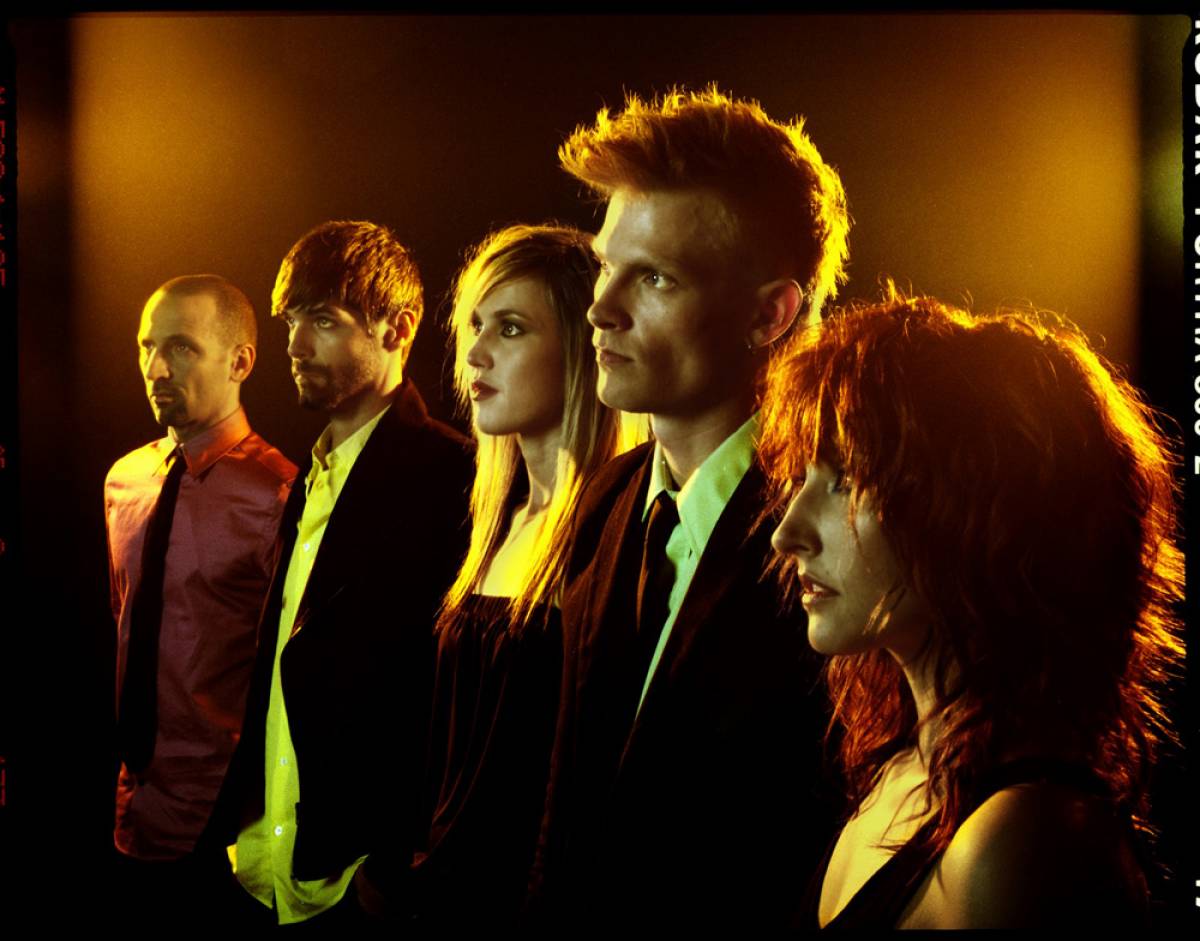
Toward the end of a sit-down chat with the Georgia Straight, Mother Mother singer-guitarist Ryan Guldemond and drummer Ali Siadat reveal one of the keys to the Vancouver band’s success to date. Mother Mother, they say, is as much a family as it is a musical act. For Guldemond, this is partially literal—his sister Molly handles synthesizer and shares vocal duties—but his relationships with Siadat and fellow bandmates Jasmin Parkin (keyboards, vocals) and Jeremy Page (bass, horns) are just as crucial when it comes to keeping the whole enterprise rolling.
Interviewed at JJ Bean on Commercial Drive on the inevitable rainy afternoon after a rare Vancouver snowfall, Siadat says that one of the things he likes best about being in a band with Guldemond is “a mutual desire for betterment of one’s craft”.
“That sounds like a euphemism,” his deadpan comrade interjects.
“It wasn’t,” Siadat insists. “I don’t even know what a euphemism is, so it couldn’t have been one.”
He’s only feigning ignorance, surely. After all, the drummer has just given this reporter a crash course on third-century-BC Greek mathematician and physicist Archimedes, who provided part of the inspiration for the title of Mother Mother’s third album, Eureka, set to be released by Last Gang Records on Tuesday (March 15). According to an account by the Roman writer Vitruvius, Archimedes was asked to determine whether an unscrupulous goldsmith had substituted some silver for the gold he had been supplied with in order to make a votive crown for a temple. Archimedes’ light-bulb moment (anachronistically speaking) occurred while he was taking a bath.
Siadat concludes the tale: “He gets into the bathtub and realizes that water gets displaced when you get into it. That led to a series of thoughts in his head that helped him figure out how he would determine whether this crown was totally made of gold. He jumps out of the bathtub and runs down the street naked, screaming ”’Eureka! Eureka!’ Or so the story goes.”
Intersecting lines on the album’s cover—which was designed by Molly Guldemond—are a visual reference to the Ostomachion, a geometric puzzle designed by Archimedes based on a mathematical formula that is too complex to even start explaining in this article. All very heady stuff for an indie-pop record, but not to worry: you don’t need a background in math or Greek history to enjoy the songs. In fact, it might help to forget everything you’ve just read about Archimedes and consider the album’s title on its own terms.
“There’s also the connotation with that word that I feel resonates with the personality of the music on this record,” Guldemond says. “It’s confident. It’s less morose than previous efforts. And eureka kind of suggests inspiration, and I guess that moment of discovery—pouncing on a naked truth and taking it for yourself.”
The overall sound of Eureka is indeed bolder and more aggressive than that of its predecessor, 2008’s O My Heart, but no less carefully crafted. Numbers like the burly rocker “Baby Don’t Dance”, the quirk-funk stomper “Problems”, and even the slow-burning meditation “Born in a Flash” bear hooks that waste little time burrowing themselves into the listener’s brain. More importantly, they don’t sound like anything other than Mother Mother, which means the band shouldn’t have much trouble shaking off the endless Pixies comparisons it garnered with past efforts such as “O My Heart” and “Body of Years”.
“Very often when we were in the formative stages of the album sonically, and in terms of working out the arrangements for the songs and deciding on how we were going to make it sound, we talked about the theme of immediacy, of songs presenting their identity as quickly as possible, as immediately as possible—sonically, lyrically, and otherwise,” notes Siadat.
Guldemond explains that this meant trying not to belabour the songwriting process, but to instead let inspiration guide it. “I think there’s some thought that goes into it, but mostly there’s freedom of thought, or a sense of being free from thought or premeditation, and just allowing the songs to unfold as they wish to, as a separate kind of moving force that you’re just kind of there to oversee or guide,” says the frontman, who is also Mother Mother’s main songwriter.
“Hopefully, you get better at writing the more you do it,” he adds. “I guess some people get worse. There’s something beautiful about the ignorance you possess when you first get into something. You don’t scrutinize it based on your education. You just express it, and it can come out in really perfectly imperfect ways. And then the more you refine it, the more it loses its freshness.”
Don’t think for a second, though, that Mother Mother went into the process of recording with only the foggiest notion of what the end product should sound like.
“This record was pretty sculpted before going into the studio, so there was a sense of confidence going in, and not too much worry or fear about us not finding our way with the shape and the personality of the record,” says Guldemond, who gets his first solo production credit in Eureka’s liner notes. “But once you get in there, things inevitably change and you do reach lots of points where you’re on the wrong track or you’ve totally botched it, but you dig yourself out of those holes and just retrack the guitar or whatever it is that you have to do to reinspire the momentum.”
The leadoff single from Eureka is “The Stand”, a slightly oddball number whose verses follow a question-and-answer format. In the song’s video, Parkin and Molly Guldemond cross-examine Ryan in a stark white shrink’s office straight out of 2001: A Space Odyssey. “Tell me your fears,” they demand, to which he responds: “Okay, it’s everyone here.” “You mean just all of the people?” his interlocutors ask. “Yeah,” he confirms, “and all of their peers.”
“I can hardly stand the sight of it all,” the song’s soaring chorus begins, and Guldemond closes things by announcing “Everybody’s fucked and they don’t even know.” If those sound like the words of someone who is not exactly a people person and who would be at his least comfortable doing something as public as, say, fronting a fast-rising rock band, Guldemond cautions against reading too much into the lyrics.
“I definitely find peace in introversion, but I can dabble in extroversion as well. But the song itself is not autobiographical. I like vodka on ice,” he notes, acknowledging one of the “weaknesses” confessed by the protagonist of “The Stand”, “but as for the rest, as for the real disdainful quality of it, I’m not that bleak in my outlook. But I can definitely relate to it in a big way. It’s easy to be a cynic in this world.”
“We all have a little bit of that in us, really,” Siadat offers. “I think that’s why people identify with that song, even if you don’t look at the world in that way completely all the time. It’s not so black-and-white anyway. Sometimes you’ll see it in a very positive way. Very often, I think people will disdainfully look upon the rest of the people in the world as a confused, almost psychotic bunch.”
If the members of Mother Mother have a rosier point of view than that, it should serve them well in the weeks and months to come. Guldemond says the quintet plans to spend as much time on the road in support of Eureka as it can. The band is slated for a pair of homecoming performances in early May, both shows being part of the Straight Series. Before that, though, Mother Mother’s itinerary takes it across Canada—well, as far east as glamorous Hamilton, Ontario, at any rate—and down to Austin, Texas, to showcase at the South by Southwest festival.
Touring as much as is humanly possible is a notion Guldemond and his bandmates can easily entertain, given that they no longer rely on day jobs to cover the rent. “Today that is the case,” he says. “But it’s a day-by-day thing. It’s still no luxury ride.” In other words, music does pay the bills, but the key to that, Guldemond says, is “just keeping the bills modest”.
As for Siadat, he has no plans to put down his drumsticks and start reading the Employment Paper cover to cover, even in the highly unlikely event that Mother Mother should implode. “Why would I do anything outside of music?” he says. “When your expertise leads you to a certain place, it kind of feels like, ”’Okay, if this band didn’t work out, and this wasn’t here as a source of income, then create something new.’ ”
That shouldn’t be necessary, so long as Mother Mother’s family dynamic stays intact. Which brings us back to the matter of the bandmates’ mutual admiration. “I like Ali because he’s wise and he’s a nice guy,” Guldemond states. “He’s a great drummer and he’s a best friend. And he’s not selfish. I can’t be in a band with selfish people.”
Mother Mother has no room for solipsists—not when the band is kicking off its latest tour by hauling itself and all of its gear to Buffalo, New York. That’s a lot of time in a van with the same four people for company. Not that Guldemond is bitching about logistics. “We can’t complain,” the singer says. “It’s truly a privileged existence that we live.”
Really? But surely it doesn’t feel that way on day four of a five-day drive, your belly full of greasy truck-stop hash browns and gas-station coffee. “Sometimes it feels like it more than ever, all cozy and tucked away in the bench seat of a van, deep in a good book,” Guldemond insists. “It’s pretty all right.”
Mother Mother gets dynamic (2012)

This article originally appeared in The Georgia Straight.
You’ve got to give Ryan Guldemond points for brutal honesty. Or, at the very least, for serious self-deprecation. “I’m not very smart,” the Mother Mother frontman says at one point during a telephone interview with the Georgia Straight. In the next breath, however, Guldemond notes that the writings of 19th-century transcendentalist Ralph Waldo Emerson helped inspire Mother Mother’s latest album, The Sticks, an assertion that undercuts his claim of weak-mindedness.
Where Guldemond earns credit for his candour is in his willingness to admit that there was no grand design behind The Sticks. Apart from agreeing that it didn’t want to create a carbon copy of last year’s Eureka, the Vancouver band entered Mushroom Studios with very little idea about how it wanted its new record to sound.
“We didn’t mess around too much with forecast or premeditation,” says Guldemond, reached on the road in Edmonton. “It was just, ‘Let’s go hole up in Mushroom for five weeks and make a really dynamic record. If there was something focal going in, it was the idea of dynamics and how much we appreciate dynamics—in music, in life, in everything.
“We wanted it to be big and ambitious but also have those really quiet, nuanced moments, which I think it does,” the singer and guitarist continues. “The last record was more of a juggernaut of one energy, and one intention, and even one sonic texture. And with The Sticks, we really wanted to kind of bounce around and dip and peak.”
That’s a pretty accurate description of how the album unfolds, from the neon-flashbang pop-rock single “Let’s Fall in Love” to the beach-fire acoustic sing-along “Dread in My Heart” to the wide-open-spaces closer “To the Wild”. Guldemond and his bandmates—singer-keyboardist Molly Guldemond, keyboardist-vocalist Jasmin Parkin, drummer Ali Siadat, and bassist Jeremy Page—take the listener on an eclectic ride.
“It just felt like the correct approach for us at this chapter of our lives—just to pick songs for their individual merits, and not for their supposed cohesion with other songs,” Guldemond explains. “The whole idea of cohesion wasn’t overly appealing this time around. It didn’t make sense. What made sense was to pick the best songs even if they weren’t so akin to other songs on the record—sonically speaking, that is. Lyrically, it’s definitely the most thematic thus far out of all our records. So maybe that cohesion makes up for the sonic diversity.”
The theme, as laid out in songs such as “The Sticks” and “Bit by Bit”, is a little bit Walden and a little bit Into the Wild, with Guldemond plotting his escape from the city and building a cabin in the woods, far away from traffic jams and smartphones. But don’t expect the singer to pull up stakes and fritter away the rest of his days in a shack on Quadra Island, where he grew up. He’s also not likely to leave a trail of ashes in his wake, as suggested in “To the Wild”: “Gonna take that old apartment/Set that place on fire/Gonna leave the world at large and/Run back to the wild.” Still, Guldemond says his lyrics reflect concerns that are very close to his heart.
“I could definitely root up some weighty opinions about the state of the modern time and urban societies’ dependencies on their man-made things,” he says, “so it was less fictitious, and less detached. Because that’s usually how I feel with much of the sentiment behind Mother Mother’s music. But with this, there was a bit more of a personal touch on the whole thing.”
Detached might be too strong a word; Guldemond’s tendency to take the outside observer’s point of view serves him well on “Let’s Fall in Love”, which winks knowingly in the direction of Cole Porter while offering the sage (and impossible-to-follow) advice that romantic entanglements are best avoided.
It’s one of the band’s catchiest songs, and it seems destined to become a fan favourite at future Mother Mother shows. At the moment, though, Guldemond reports that crowd response is strongest for selections from 2008’s O My Heart, which was Mother Mother’s second LP and its ticket to a wider audience.
“Those old songs from O My Heart never fail to incite much enthusiasm—like ‘Wrecking Ball’ and ‘Hayloft’, especially,” Guldemond notes. “ ‘Hayloft’ is fun because we always disguise the intro, or the drop of the beat, and inch towards it, and people are like, ‘What is going on?’ And then it surfaces and, every time, everyone goes wild. It’s almost comical at this point, because it’s such an easy little trick with our own fans. I mean, it’s a wholesome trick. It’s very sweet and funny.”
 John Lucas
Leave a comment