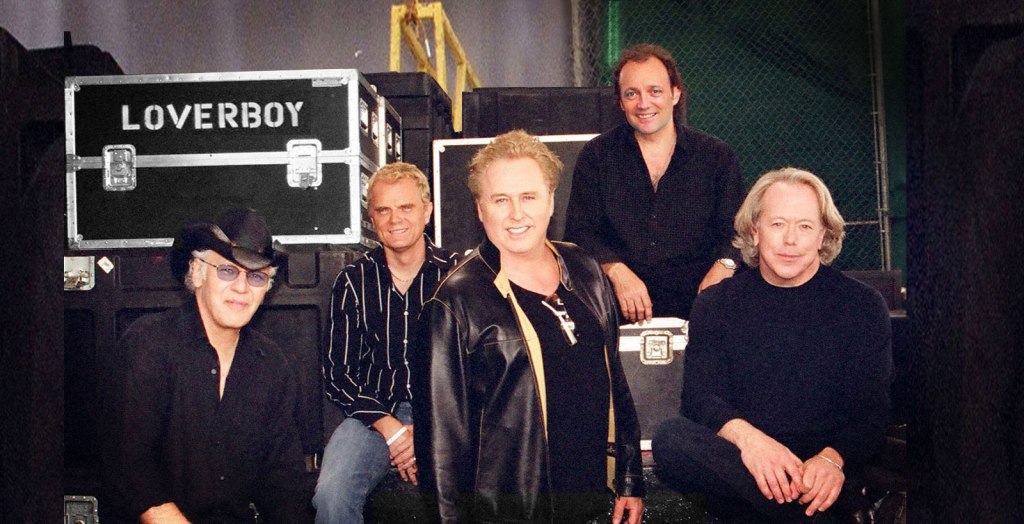
I recently interviewed Loverboy guitarist Paul Dean for an upcoming Montecristo feature on the 45th anniversary of the band’s self-titled debut album. It reminded me of the time I interviewed Dean on the eve of Loverboy’s induction into the Canadian Music Hall of Fame. Here’s the piece I wrote back then.
Thirty rocking years in, Loverboy keeps it up
This article originally appeared in The Georgia Straight.
Give Paul Dean credit for not letting his rock-star status go to his head. When his band hit it big in the U.S. and the cheques started rolling in, the Loverboy founder didn’t squander his riches on a diamond-encrusted Rolls-Royce or a fleet of platinum-plated Learjet 25s. Instead, the guitarist invested in something far less ostentatious.
“There were a few years there where it was incredible, the amount of money that was coming in,” Dean recalls, on the line from his home in Calgary. “And my manager and good friend Lou Blair said, ‘First thing you do, you buy a house.’ And I went, “’Okay.’ Actually, the first thing I bought was a Harley, but that’s what he said, so I did it. And I’m really glad I did.”
If Loverboy had been an overnight success, Dean might have been more tempted to spend lavishly, but the project had its share of hungry years. A former member of Streetheart, the Vancouver-born guitarist hooked up with singer Mike Reno and keyboardist Doug Johnson while living in Calgary. The Loverboy story really started, however, when the three relocated to the West Coast in the summer of ’79 with a batch of songs and stadium-sized ambitions. With the addition of drummer Matt Frenette and bassist Scott Smith, the band was complete, and the real work began.
Loverboy signed to the Canadian division of Columbia Records, which released its self-titled debut album in 1980. Below the 49th parallel, a few influential DJs started to take notice of the act’s north-of-the-border success. But what really helped Loverboy crack the U.S. market was a period of intensive touring, for which Dean gives much credit to promoter Don Fox. “Don started us off on an April Wine tour, and I think there were a couple of other little ones, too,” the guitarist says. “And then we got on a tour with Kansas and one with ZZ Top, all in the space of two years. It was unbelievable. We worked 250 shows, I swear, in one year. Nonstop. But that’s what you’ve got to do.”
It paid off. Loverboy’s highly marketable sound, which combined rock-hard guitar riffs with new-wave synthesizers and mammoth pop hooks, struck a chord. And it probably didn’t hurt that Reno looked pretty good in a headband and nut-hugging leather trousers. Before the ’80s ended, the band released five albums that went gold or platinum stateside. Hits like “Turn Me Loose” and “Working for the Weekend” remain rock-radio staples, even if the critics of the day didn’t cut them much slack.
Dean acknowledges that the lyrics to “Hot Girls in Love” aren’t exactly deathless poetry, but he says he and his bandmates never aspired to rival William Butler Yeats. If they had, they might have spent a little more time on the words. “It’s like you have a motorcycle, and you’re building it from scratch,” he says. “You go out every day and you look at it in the garage, and it’s almost finished. Let’s say you’ve got five or six more chrome parts to put on it, and you know it’s going to be just perfect, but you say, ”˜I don’t care. I want to ride this sucker right now.’ So you get on it and you have a blast with it. I think that’s what we did sometimes. I mean, we were really cranked. We couldn’t wait to release the songs and get them out there. That’s not to say that I’m not proud of them.”
He’d better be. After all, he still plays them on a regular basis. Loverboy briefly broke up at the end of the ’80s, but since re-forming in the early ’90s the group has continued to tour and occasionally record. Smith died in a tragic boating accident nine years ago, but Loverboy soldiers on with bassist Ken “Spider” Sinnaeve, another Streetheart alumnus. (In recent years, the band has dedicated itself to worthy causes; in 2000, it launched Rockin’ for Research, an annual concert series that to date has raised an astounding $5 million for the Juvenile Diabetes Research Foundation.)
Moreover, Dean has a damn good reason to be proud of Loverboy’s songs: they were solid enough to get him and his bandmates inducted into the Canadian Music Hall of Fame, alongside Joni Mitchell, Neil Young, and the Guess Who. “To me, that’s the most important thing in my career, is being a songwriter,” Dean says. “That’s what I take the most pride in, so to be associated with Joni and Neil and all these other people, like Leonard Cohen—are you kiddin’ me? It’s pretty incredible.”
 John Lucas
Leave a comment