
Just to keep you, my faithful readers/fans/stalkers up to date, I thought I would share a roundup of my recently published work, including two arts features for Stir and a piece I wrote just for fun and posted on Medium.
Four things in Vancouver that aren’t actually called what you think they’re called
(Medium, September 2, 2025)
Canada’s third-largest city, Vancouver, British Columbia, is a popular tourist destination and one of the biggest film production centres in North America.
It is also home to many people whose favourite hobby seems to be collating lists of everything that sucks about Vancouver. These droning bores are no fun whatsoever and I advise you to avoid them and their wearying ways.
It’s fair to say that many people presume to know a lot about the city—but there are things that even locals get wrong.
Here are a few spots that the most knowledgeable Vancouverites routinely refer to incorrectly, and what they’re officially called.
Yota Kobayashi explores the nature of perception and reality in Shiki & Kū
(Stir, September 4, 2025)

TO FULLY GET A handle on the concepts at play in Yota Kobayashi’s installation Shiki & Kū, it might help to start with a definition of the title. Then again, it could be better to just let the experience wash over you, with no preconceived notions of what it all means.
In any case, when Stir connects with Kobayashi, the Vancouver-based soundscape artist is only too happy to define shiki.
“It could mean, in English, form, or tangible reality,” he explains. “Things that you can recognize—say, a chair that you can sit on, a tree that you can see, sounds that you can hear, love that you can feel, touch that you can experience. Something like that.
“And then kū, on the other hand, that means emptiness,” Kobayashi continues. “That’s the only word I could find in the English language. But it doesn’t mean nothingness or nothing. Instead, it means that those realities, like shiki, they’re all impermanent. The realities can exist only through imagination, as they are discerned.”
Portrait of stifling patriarchy in A Doll’s House retains powerful relevance
(Stir, September 8, 2025)
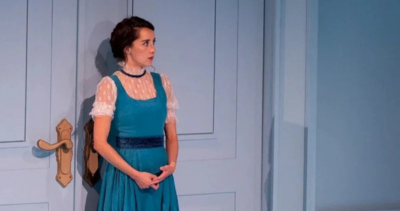
Theatregoers’ sensibilities have changed considerably since Ibsen’s day. A Doll’s House—which tells the story of one Norwegian woman pushing back against a stifling marriage and a broader society that offers her little opportunity of escape—retains all of its power, even as its moral ambiguity is less shocking now than it must have been in 1879.
When American playwright Amy Herzog adapted the play in 2023, her intent was not to blunt its impact, but to streamline the story and strip away the trappings of 19th-century Norway.
“I would say Amy stays pretty loyal to the core story and narrative and point of view of the script,” says Alexandra Lainfiesta, who plays Nora in the Arts Club production of Herzog’s adaptation. “I think what she does with this adaptation is, she really brings clarity and immediacy. She makes the language startlingly present; it feels like today. She trims away any of the ornate 19th-century language that is in Ibsen’s play, and it really gives Nora—and, I would say, all the other characters—a dialogue and speech that feels sharp and lived-in and urgent. It’s a very visceral, immediate adaptation.”
 John Lucas
Leave a comment