
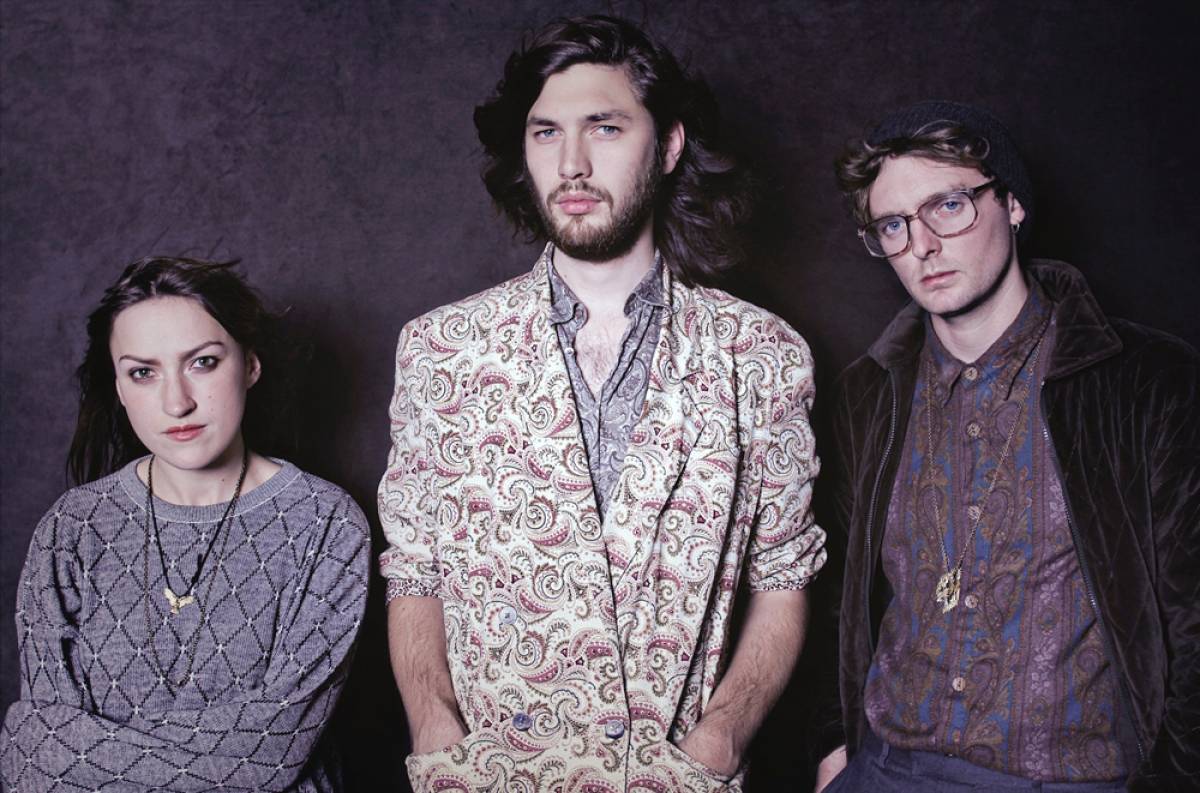
On this day in 2013, the underrated British alt-rock trio Esben and the Witch played at the long-gone and much-missed Media Club in Vancouver. A couple of years before that, the gothic-leaning band also played Vancouver in March (at the Waldorf on the 26th), so I thought it made sense to revisit both of my interviews with the group’s drummer (and former guitarist), Daniel Copeman.
Esben and the Witch has no interest in labelling its sound (2011)
(This article was first published by the Georgia Straight.)
In the Danish fairy tale “Esben and the Witch”, the youngest and smallest of a farmer’s 12 sons saves his brothers from losing their heads to an evil, bearded old hag by tricking the witch into beheading her own daughters instead. And that’s at the beginning of the story!
English musician Daniel Copeman plays in a band named after the grim tale. Reached at a tour stop in Toronto, the guitarist says, “It’s your classic sort of underdog fairy tale, but with a few sort of malevolent twists, where people get their heads chopped off and people get burned in ovens and stuff like that. It’s quite macabre, but we’re drawn to the imagery and everything of it.”
Indeed, the music of Esben and the Witch, as heard on the Brighton-based trio’s debut LP, Violet Cries, is dark and foreboding, shot through with a threat of imminent sonic violence that never quite materializes, lending the whole affair an air of unresolved tension. The focal point is singer Rachel Davies’s plaintive voice, saturated in reverb and surrounded by alternately crashing and ebbing waves of delay- and chorus-treated guitar and electronics, courtesy of Copeman and multi-instrumentalist Thomas Fisher.
You could call it gothic rock (as many already have), but not if you’re hoping to get on Copeman’s good side. He’s heard all the Siouxsie and the Banshees comparisons he wants to hear, thank you. “It feels very glib for someone to say to a band, ‘You haven’t made something new; you’ve just made something that sounds like it was made 20 years ago,’ every time the band does something,” he says. “From a journalistic point of view, it seems strange that journalists wouldn’t want to describe what they’re hearing in a new way.”
In fact, Copeman has no interest in labelling what Esben and the Witch does at all. “People seem to have to put a genre on something, otherwise they don’t feel like other people will be able to understand what they’re talking about,” he says. “I’d like to give people more credit than that.”
Copeman and his bandmates probably don’t have much time to ponder what their music should be called in any case. Things have moved pretty quickly for Esben and the Witch since it put out a self-released EP called 33 in late 2009. The trio’s audience expanded immeasurably when Pitchfork posted one of its tracks, the incendiary “Marching Song”, the following January. Tours with the likes of the Big Pink, School of Seven Bells, and Deerhunter followed, as did the inking of a deal with Matador Records.
All very awesome, and Copeman insists he isn’t taking any of it for granted. “It never gets any less exciting,” he says. “Touring North America as a headline band is something that none of us ever expected to have the opportunity to do, and it feels bizarre but wonderful at the same time. Being able to come to Vancouver and play a gig—I didn’t think I’d ever get to go to Vancouver, let alone go do something that I loved.”
Esben and the Witch takes a more organic approach (2013)
(This article was first published by the Georgia Straight.)
If you were one of the few who caught Esben and the Witch at its first Vancouver show two years ago, consider yourself lucky, because it was an experience that will never be re-created. This is true in part because it took place at the Waldorf (R.I.P.), but also because the English band has reconfigured itself since then, as Daniel Copeman explains. Reached on the road somewhere between Montreal and Toronto, Copeman says that, although Thomas Fisher remains on guitar, he and singer Rachel Davies have switched up their duties for the tour in support of the new Esben and the Witch LP, Wash the Sins Not Only the Face.
“I’m kind of trying to learn the drums as we play shows, which I’m sure is wonderful for audiences who watch me miss beats all the time, but I’m getting there,” Copeman says. “We wanted it to have a bit more of a groove, and a bit more of a live feel to this record, so I’ve stopped playing guitar. And Rachel’s playing more guitar and bass, and I’m doing all the percussive stuff and the synth stuff. Hopefully, it gives it a bit more of an aggressive live feel than it used to have.”
A more organic approach is in keeping with the overall vibe of Wash the Sins. The album retains some of the into-the-black gothic menace of the trio’s first full-length, Violet Cries, but adds in brush strokes of pastel-hued dreaminess, as on the aptly titled “Shimmering” and “Deathwaltz”, which enchants with ethereal melodies but verges on postrock thanks to its dynamic shifts and unorthodox chord changes.
Even more impressive is “When That Head Splits”, which begins with a full minute of slowly building drones before bursting into what, in the world of Esben and the Witch, counts as a pop tune. In the song’s striking video, a woman wanders through, and slowly melds into, a surreal forest landscape. The video’s director, Rafael Bonilla Jr., is heavily under the influence of science fiction, while the song itself was inspired by Salvador Dalí’s painting Metamorphosis of Narcissus, which in turn was based on Greek mythology. Layers upon layers!
“That’s what fascinates us about a lot of our favourite bands and artists,” Copeman notes. “Invariably, everybody’s referencing or is influenced by something.…It’s odd how there’s a lot of circular processes there, where you’ll be influenced by something that someone else has done, and their influences go back to something else, and their influences go to something else, and then you end up almost back where you started. There’s kind of an Ouroboros-like element to the way people are so inspired, where the snake is eating its own tail.”
If you’re getting the idea that Wash the Sins is sort of a cerebral listen, you’re right—Copeman points out with pride that copious research helped shape Davies’s lyrics—but that doesn’t mean it isn’t also an accessible one. That’s one of the things that set it apart from the bleak-yet-cathartic Violet Cries, which Copeman admits was “difficult to listen to”, and deliberately so.
“From my point of view, there was a bit of a mentality, an us-against-them idea, where I wanted to make something that was quite aggressive and oppressive and intense,” he says. “Maybe being more confident, and having toured, and feeling more comfortable with being in a band who are releasing records on Matador, the second one, to me, was supposed to be much more of an inclusive experience. People could get inside the record and could actually enjoy it. But, yeah, oppressive is the word for the first one, unfortunately. I don’t know if many people set out to write oppressive records anymore.”
 John Lucas
Leave a comment