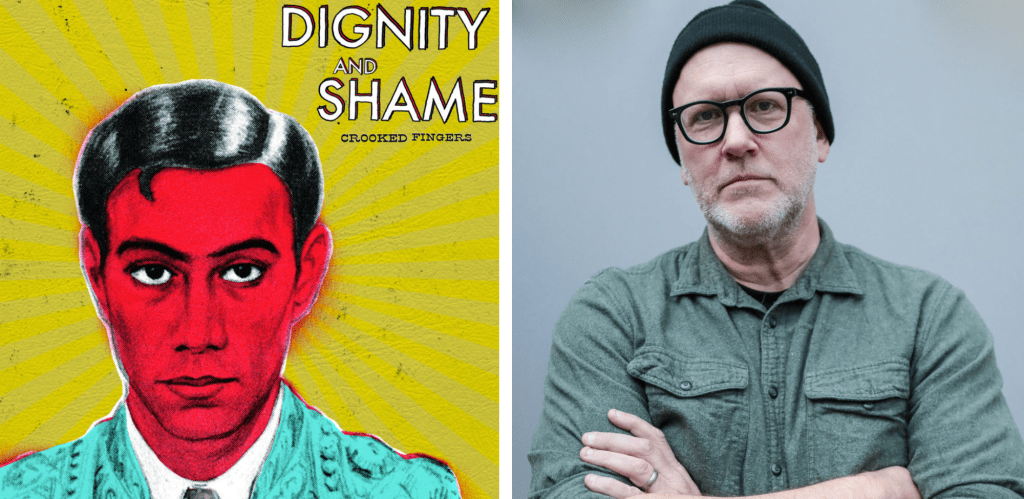
Twenty-one years ago to this day, Crooked Fingers played a show at the long-gone and sorely missed Richard’s on Richards in Vancouver. A few days before that, I had the opportunity to interview Eric Bachmann about his project’s latest album, Dignity and Shame.
Crooked Fingers singer wants to move somebody
(This article originally appeared in the Georgia Straight.)
Depending on whose opinion you choose to heed, the latest Crooked Fingers record, Dignity and Shame, is either veteran tunesmith Eric Bachmann’s masterpiece or a serious misstep. Reviews in SPIN and Billboard have pegged the disc as the finest entry to date in the band’s catalogue, but Pitchfork’s Marc Hogan was less charitable. Comparing the album’s relatively lighter selections with past triumphs such as “New Drink for the Old Drunk” and “Angelina”, Hogan opined that “At a bar, those tracks would be ordering whiskey shot-for-shot with W.C. Fields while most of Dignity and Shame was in the bathroom spewing its second sangria.”
Bachmann isn’t particularly interested in what Hogan and his ilk have to say. You won’t catch the former Archers of Loaf frontman visiting Pitchfork, or any other music sites, in search of his own name. “It doesn’t seem beneficial to go places on-line that are discussing your reputation,” the Seattle-based musician says, reached at a tour stop in Philadelphia. “It just doesn’t do me any good. It makes me feel self- conscious and weird. I always feel like it’s not my business what anybody thinks of me. I just feel like if I read that stuff it gives me a bad energy or makes me overly self-aware. I have more fun when I don’t know that stuff’s going on.”
The album that’s dividing the critics is Crooked Fingers’ fourth, and it is certainly the most diverse effort yet from Bachmann and his rotating cast of coconspirators. Dignity and Shame opens with “Islero”, a flamenco-flavoured instrumental, and returns to Spain for the matador anthem “Andalucia”. Throughout the disc, Bachmann introduces a parade of memorable characters—the usual assortment of jaded girls, drunken wastrels, and heartbroken lovers—and works in a number of musical styles, from weepy country (“Sleep All Summer”) to piano balladry (“Dignity and Shame”). Most surprising are those numbers that boast a hitherto unexplored accessibility, especially the radio-ready “Twilight Creeps” and “Call to Love”, on which Bachmann’s creaky voice is joined by that of the dulcet-toned Lara Meyerratken.
Bachmann won’t go so far as to admit that he’s making a bid for mainstream acceptance. “Nothing I do musically is on purpose,” he insists, but he does acknowledge that he has given more thought lately to communicating with people. Before, he claims, he took the same attitude toward potential listeners that he takes to music critics: he didn’t spend much time pondering how they might respond to his work. “Now I almost feel that it should be some sort of service,” he says. “Not in an arrogant way or a self-important way, but just like, ‘Well, gee, if I write this song and somebody gets something out of it, that’s pretty great,’ you know? I would love to move somebody in the way that Roberta Flack’s First Take moved me or a Townes Van Zandt song moves me or a Leonard Cohen song moves me. I’d love to do that. I’m not saying I can or I have done that, but I sure do want to try. That to me is the most rewarding thing.”


Leave a Reply