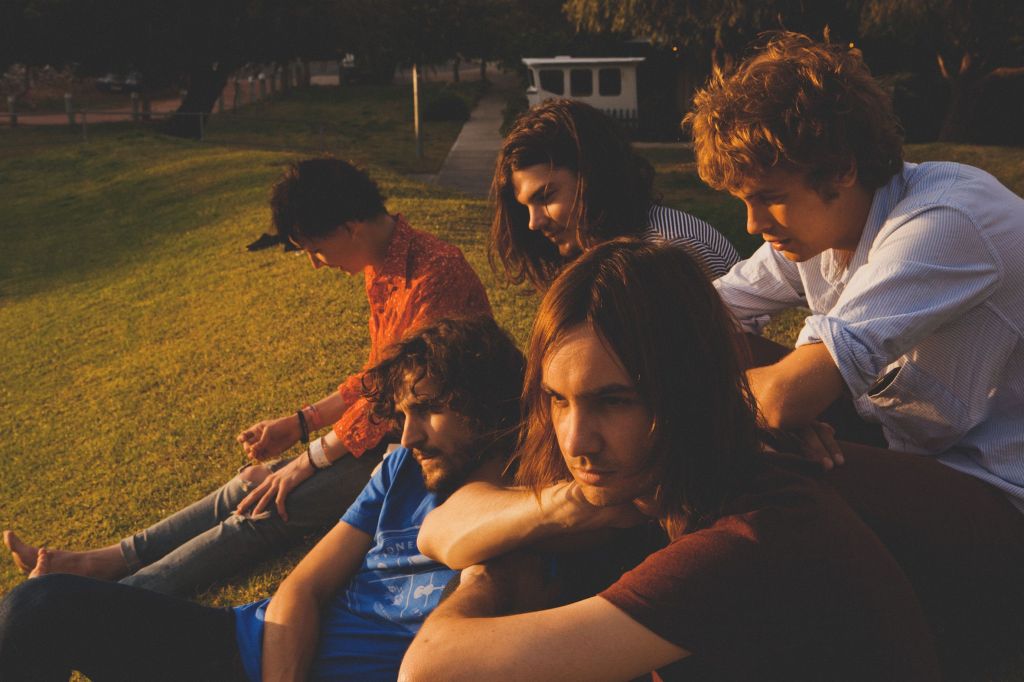
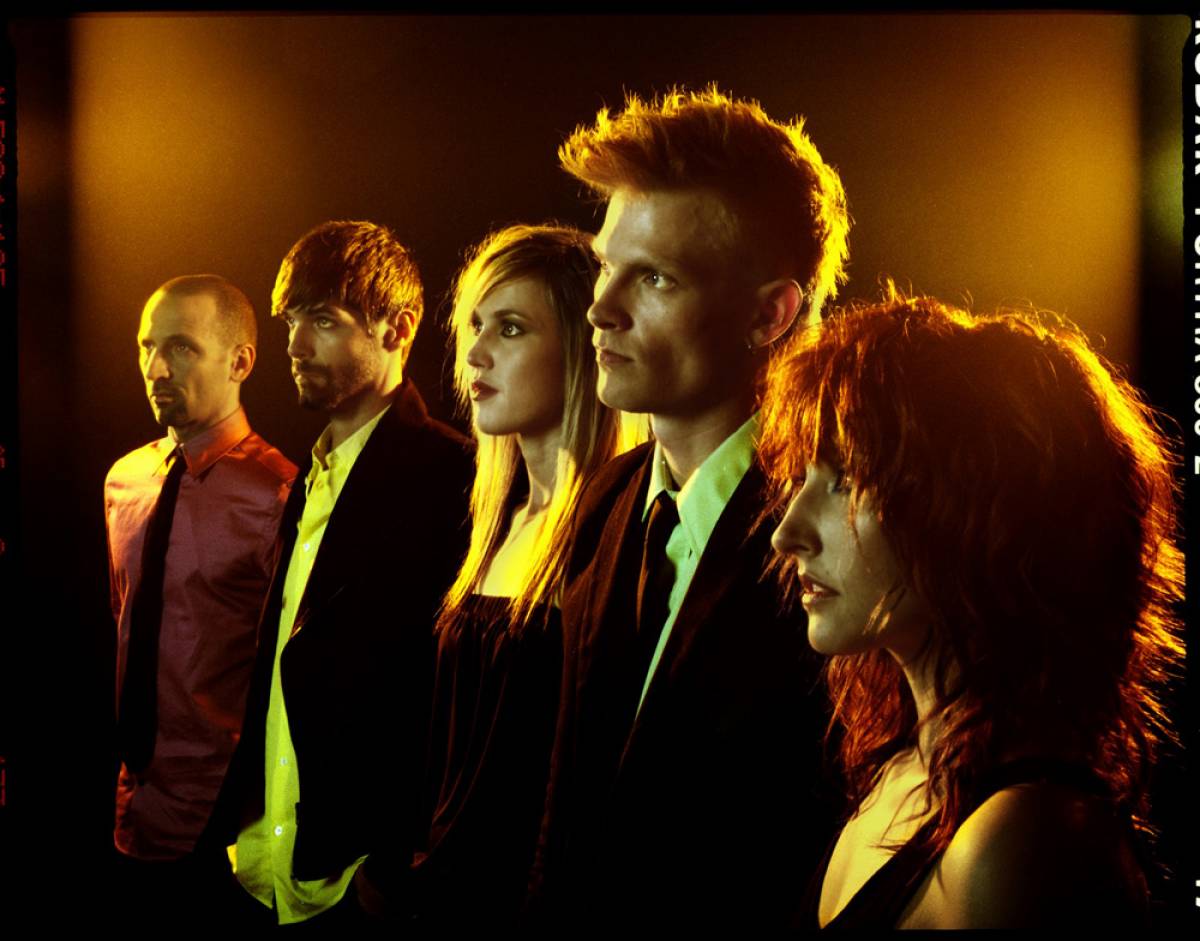
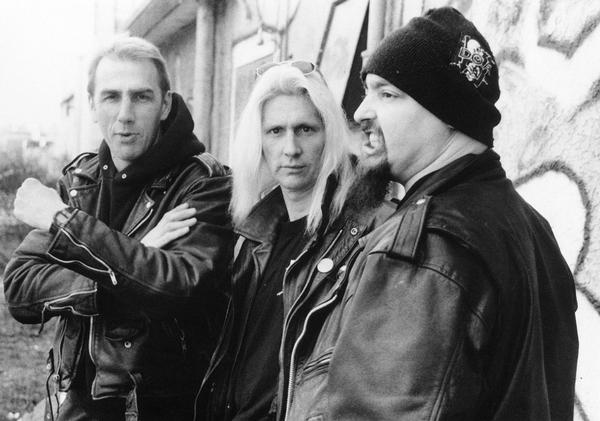
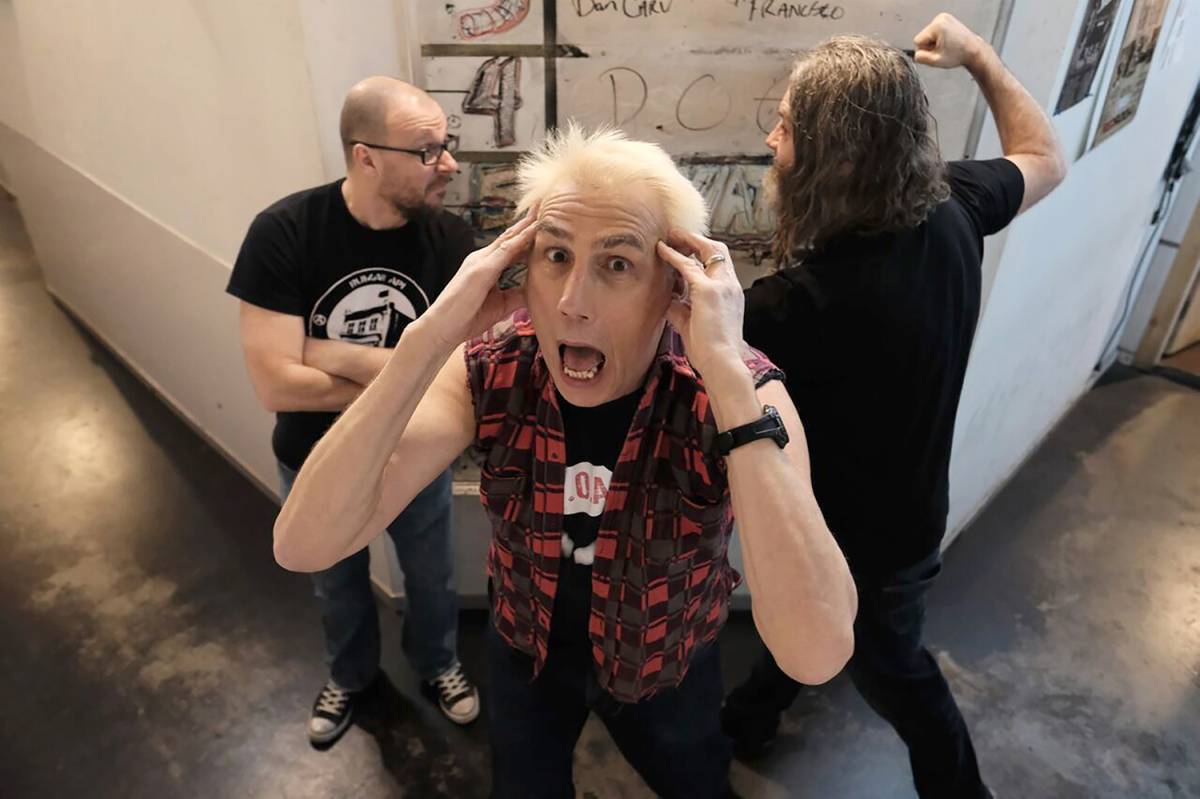
For a little while in the early 2010s, I was a regular contributor to the “Sound Check” column of a Canadian magazine called Concrete Skateboarding. This was before the era of “everything must be online, always”, so my contributions ran in the print edition but never made it to the web—until now. Back in 2012 I had the opportunity to interview Kevin Parker of Tame Impala for Concrete. I have always really enjoyed Parker’s music, but this is the one and only time (to date) that I have interviewed him.
Sound Check: Tame Impala
For someone with a reputation as something of a recluse, Kevin Parker is a pretty friendly guy. Or at least that’s the impression the frontman for Australian psychedelic-rock outfit Tame Impala gives when he’s reached on tour in Austria. You could be forgiven, though, for assuming Parker lives a hermetic life. After all, he does live in Perth, Australia, which has been described as the world’s most remote city, and he did name the latest Tame Impala album Lonerism. The previous one, released in 2010, bore the navel-gazing title lnnerspeaker, and its standout track, “Solitude Is Bliss”, contained one of Parker’s most telling lyrical couplets: ”There’s a party in my head/ And no one is invited.”
On the line from Vienna, however, Parker refutes the perception that he’s a loner. “At the moment I’m not alone at all, because I’m on tour with my friends,” he notes, adding with a laugh, “The last time I was alone was when I went to the toilet.”
There may be something to the notion that the musician relishes his moments of isolation, however. Consider the fact that Tame Impala is essentially a one-man creative outlet, with Parker writing all the songs and recording all the parts himself. “Generally it’s just me slowly putting songs together,” he says. “That’s just the way it’s always been. It’s totally a solo project in the studio, but no one seems to consider it that. Everything I’ve read has just been ‘Tame Impala, the band.’ I’m not really put off by that or anything. It’s just the way people see it, because they see a bunch of guys on a stage playing the songs, so they assume it’s a band, but it’s totally not. When we play them live, we all get together and take the song that’s already been recorded and interpret it. We just sort of have fun with it, basically, and that becomes the live version.”
Impressively, Lonerism sounds like the product of a group of people. It’s all Parker, though, and while the Fab Four vocal harmonies and acid-washed guitar licks of songs like “Mind Mischief” and “Apocalypse Dreams” suggest he hasn’t lost his taste for paisley-skies psychedelia, there are plenty of elements that set this LP apart from its predecessor. Foremost among these is Parker’s ample use of keyboards, adding layers of pastel-washed synth tones to tracks like “Why Won’t They Talk to Me?” and “She Just Won’t Believe Me”.
“I was just feeling like looking to other things to get new crazy sounds,” he explains. “I’m always trying to find the craziest sound, you know—the thing that sounds the least like it comes from Earth. It’s really difficult to do that with guitars, because whatever you do with a guitar, it’s usually going to end up sounding like a guitar. It’s going to have that kind of earthy, rock ‘n’ roll feel. But with synthesizers, they just start in a completely different place. It was just really kind of exciting to have this whole new playing field of sounds and emotions.”
As much as Tame Impala’s music makes ideal bliss-out fodder for those who like to indulge in things green and leafy, Parker’s command of melody makes it worthy listening for those who simply want to hear a good tune. Some might hesitate to call it pop, but not Parker, who claims he’s got an entire album’s worth of songs just waiting for his fellow Aussie Kylie Minogue. The man loves hooks, and he doesn’t care who knows it.
“As long as you do something that feels cool, or sounds cool, or gives you some sort of emotion, then nothing’s ever too cheesy, or not cheesy enough,” he says. “It really just depends what you consider to be pop and what you consider not to be pop, which is a totally subjective thing anyway.”
Need an amazing bio, press release, or web copy written for your band or solo project? I’m your guy.
A former Associate Editor at the Georgia Straight (Vancouver’s news and entertainment weekly), I have three decades of professional experience as a music and arts journalist under my belt. In more recent times I have shifted my career focus towards public relations and marketing.
I also have experience running an independent record label, writing all of the promotional materials for several releases that ended up charting on a national level.
Long-running Vancouver indie-rock juggernaut Mother Mother released its 10th album, Nostalgia, earlier this month. With the group spending its summer touring across Europe, it seemed timely to revisit my past interviews with frontman Ryan Guldemond (and the occasional bandmate). Digging through the archives, I discovered that I have actually written about Mother Mother quite a lot over the years, so I have decided to split this blog post into two installments. This is the second.
Ryan Guldemond doesn’t set out to make grand statements, but somehow it keeps happening. Mother Mother’s last album, 2012’s The Sticks, found Guldemond—the band’s singer, guitarist, and songwriter—drawing inspiration from the writings of Ralph Waldo Emerson and his own rural upbringing to paint a lyrical portrait of someone determined to turn his back on modern urbanism and retreat to the woods.
For the Vancouver act’s major-label debut, the just-released Very Good Bad Thing, Guldemond meditated on the human mind, with an eye on the darkness contained therein. Not that this was necessarily something he was trying to do.
“It’s easy to spin it into some kind of cohesion after the fact because you need to do that in interviews and stuff,” he says on the line from a Red Deer tour stop, “but it wasn’t premeditated as being a conceptual statement on humanity. But it is, and I think that’s the beauty of making songs and creating, is that you’re not supposed to know what it collects into as you’re doing it.”
Very Good Bad Thing doesn’t take long to get down to the business of exploring Guldemond’s obsessions. The need for personal space he explored on The Sticks rears its head again on the new album’s stomping opener, “Get Out the Way”: “I’m not antisocial, I’m just tired of all the people/And I’m fine with rolling solo.”
The narrator of “Reaper Man”, on the other hand, makes no such claims; he knows damn well that he’s antisocial, and he revels in it: “How’d I ever get so indiscreet? How’d I ever get so freakly?/Everybody out there on a leash/But not me.”
“I think you’d have to be pretty lost or closed-off as an individual not to realize that each person is a vehicle for grave flaw and grave sin, in counter to that infinite potential for creativity and beauty,” Guldemond insists. “So that’s what all the songs are about, each and every one. ‘Reaper Man’ just happens to be about a guy championing his own darkness. Because we all have it, you know. Everybody thinks the monstrous thing—and the only reason why it’s determined we’re a monster is if we act on it, but the thought was had. So I guess that’s how I see life, and people.”
Despite the heady subject matter, Very Good Bad Thing features some of Mother Mother’s most pop-leaning material to date. “Modern Love” is not a David Bowie cover but a buzzing electro banger aimed squarely at the dance floor, while “Monkey Tree” is a hook-barbed midtempo crowd-pleaser with a colossal chorus made for rapturous audience sing-alongs.
The band—which also includes keyboardists-vocalists Jasmin Parkin and Molly Guldemond, bassist Jeremy Page, and drummer Ali Siadat—recorded its latest batch of songs in Toronto with producer Gavin Brown. Guldemond has been credited as producer or coproducer on the last few Mother Mother albums, but he says he was happy to hand the reins over to Brown (whose CV includes releases by Metric and the Tragically Hip) because it took some of the pressure off of him.
“When any producer might work with a band with a fastidious leader-type person—or annoying despot character—I think they will find use in that personality, and help elucidate the band’s identity using that person,” Guldemond says of his role in the process. “That will happen, invariably. But, that being said, the lines were clear: I was not producing this record, so I could step away, emotionally, and not have to answer to the hard questions of ‘Where is this record going?’ and ‘Why is it sounding more yellow than purple?’ two months in. Which is what always happens. Everyone freaks out about what’s taking shape.”
To hear the frontman tell it, though, there were considerably fewer in-studio freak-outs this time around. Guldemond says recording gets easier with experience, both in a technical sense and in a spiritual one, if you will.
“That’s the deal: you make more records, you stop spazzing out along the way,” he notes. “It’s a little bit more like clockwork. There’s a naivety in your first record that can birth beautiful creation, whimsy, spontaneity, blah… But it can also just trump productivity: ‘Ah, fuck—why do the vocals sound weird and close and up-front and to the left?’ It’s like ‘Well, because we’re recording it right now in this way, and it’s a part of a production, so shut up and wait till it’s done, you fool.’ ”
Guldemond says that, in working with Brown, he and his bandmates got over what he calls their “sonic megalomania”, or proclivity toward loading the songs with every possible musical idea. “Clarity was a buzzword throughout the whole process,” he says, acknowledging that in taking this approach, Mother Mother streamlined its sound, sacrificing some of its signature eccentricity along the way. Guldemond views the group’s having shed some of its quirks as a positive development.
“I think ‘weird’ can act as a gimmick, when you discover it’s your tendency and it works and you expand upon it purposefully,” he says. “So that’s something to be wary of.”
On its current tour, which ends with a homecoming show at the Orpheum this weekend, Mother Mother has been performing only one song from its 2007 debut album, Touch Up. Guldemond says “Dirty Town” shows just how much the project has evolved from its weirdness-for-its-own-sake beginnings.
“It’s quirky, and it just throws all these brash and brazen idiosyncrasies out there,” he admits. “And that’s so much part of its charm, but it’s just a lot of weight in the realm of eccentricity. It was born out of naivety; it was born out of someone floundering and flailing in the creative landscape. I think it’s beautiful, but it does need to be reined in. And that’s just part of growing up, surrounding how you want to present your sentiments, how you want to truly focus your message. And I suppose there is a lot of that taking place right now, and that will continue to take place, and to take shape.
“Yes,” the sardonically witty frontman concludes, “we will become very boring eventually, because we’ll become so mature in our songwriting.”
Fear not, music fans: if Very Good Bad Thing is evidence of the band’s maturation, Mother Mother is in no danger of becoming boring.
Mother Mother’s Ryan Guldemond comes clean with honest songwriting (2017)
You’d never know it from his on-stage swagger—he looks as comfortable in the spotlight as the natural-born rock star his voice and six-string chops suggest he is—but Ryan Guldemond considers himself an introvert. His apparent bravado masks a long-standing lack of confidence, one that the Mother Mother frontman admits he once tried to obliterate with drugs and booze.
“The people that I look up to and idolize are ones who come in like a juggernaut, and I wasn’t ever able to achieve that by myself, so when I introduced substances, there was this access point to become what I idolized,” Guldemond says when the Straight reaches him by phone at a coffee shop in Ottawa. “And then that persisted for quite a long time, until the jig’s up. And now I realize that there is power in a wider spectrum of personality traits. I’m starting to discover the strength in shyness and introspection, whereas before I admonished it completely.”
Guldemond’s newly found appreciation for his essential nature, and his ability to balance it with the demands of being the face of a successful rock band, didn’t come easily. It required him to take an unflinching look at his life and assess what was making him happy and what was holding him back. His conclusion? The drugs and alcohol had to go.
“I was and had been a very debaucherous person for a long time, which was not working for me, so I decided to make a shift towards cleaner living,” he says. “Not just cleaner, but truer living, which is where the hard part of the transition lies. Because gettin’ healthier, that’s fun. That feels good. But then having to wrassle the truisms that bubble up as a byproduct is a more daunting task.”
One of the hard truths that sobriety dragged into the cold light of day was the impact that Guldemond’s lifestyle had been having on his relationship with his sister Molly, with whom he founded Mother Mother on Quadra Island in 2005. Guldemond notes that their sibling bond was “disintegrating”, which was as damaging to their musical project as it was to them personally.
“She was my greatest critic,” he notes. “Those wily ways really affected her, and it affected us, so it affected the band.”
Guldemond details his descent into dissolution on “Baby Boy”, a standout track from the Vancouver-based act’s new album, No Culture. “Baby Boy” is one of the most honest songs he has ever written, and perhaps the most emotionally wrenching entry in the Mother Mother catalogue to date. “There’s a red light up ahead,” he sings. “I drive my car into it/I’m a little kid with a big death wish/I bite the lips, the lips that kiss.”
His sister then counters his embrace of self-destruction with a heartbreaking word of caution: “Baby boy/Baby brother/We’re losing you to the gutter.”
Guldemond wrote the lyrics, but he says they are an accurate reflection of his sibling’s concerns. “I took the words right out of her mouth, and put them back in,” he says with a trace of wry amusement. “And now she has to sing it every night.”
With that decadent daze now in the rear-view mirror, Guldemond says things between him and his sister have never been better. “We’re really good right now,” he notes. “She’s waiting for me at the other end of this Starbucks, and we just got back from the YMCA. That was something that wouldn’t have happened before—us in our respective corners of the gym, striving towards betterment. So, yeah, we have a whole new lease on our relationship, and the band has a new lease on its vitality.”
In fact, the band—which also includes drummer Ali Siadat, keyboardist-vocalist Jasmin Parkin, and new bassist Mike Young—virtually crackles with life on No Culture, which opens with the riff-driven stomper “Free” and closes with the mostly acoustic fist-in-the-air sing-along “Family”. In between, the quintet makes stops for the alt-R&B-tinted “Mouth of the Devil”, the dreamily yearning power ballad “Letter”, and the insanely infectious modern rocker “The Drugs”.
That last number finds Guldemond addressing an unspecified “you” whose love is both “better than the drugs I used to love” and “deadly like a gun”. The singer seems to be suggesting that the things with which we replace our vices can sometimes deliver dangers of their own.
“It’s painted as a romance, but it’s not specific in my mind,” Guldemond says when he’s asked who or what the “you” in question might be. “It could be anything. It could be love on a more universal and interconnected scale. It could be a lover. Ultimately, I think one needs to find liberation in the self, and that’s how I spin that song when I need to relate to it. Even a romance could be its own form of addiction and dependence.”
Lest you think that the once-debauched rock star is now spreading the gospel of total abstinence, know that Guldemond is no monk. It’s just that these days, he sees the value of moderation and self-control. “I did my year, and then I began reintegrating on a more cautious, and almost sacramental, level,” he says of his relationship with alcohol and drugs. “Before, I was just overusing and indulging and skewing reality with surreality.
“But now, moving forward, should I choose to augment my experience with a guiding external force, I would like to do so with some honour of the substance, whatever it may be, and reflection, and learn something from these experiences. But right now I’m clean. I want this tour to be clear-headed.”
If No Culture exemplifies what a clear-headed Guldemond can achieve, then it seems he’s found the right balance.
IN + OUT
Ryan Guldemond sounds off on the things that enquiring minds want to know.
On sobriety not being an end in itself: “I’ve come out the other side realizing that there is a high out there that can sustain itself and that doesn’t take me down. It’s not easy to find. Or maybe it’s easy to find, but it’s not easy to understand, especially in the grip of sobriety, or the faulty psyche that most people possess. I often like to describe sobriety as a drug of inhibitions and fear. Just because you’re not imbibing or ingesting mind-altering poisons doesn’t mean you’re liberated or free and performing life to your ideals.”
On his evolving songwriting voice: “It’s true that the writing was more sardonic, and that’s because it’s a lot easier to smirk at the troubles within the world than it is at your own personal troubles. We get a little more weepy when we’re dealing with our own crises. So, yeah, the writing naturally took on a more honest and vulnerable flair.”
On revealing more of himself in his lyrics: “I haven’t found comfort in it completely, but I realize that it’s where the good stuff lies.”
Mother Mother prepare for five upcoming shows at Commodore Ballroom (2021)
In their zeal to keep moving forward and growing, artists often dismiss their earliest work as the product of a half-formed sensibility—the new stuff is what really matters. Ryan Guldemond, on the other hand, says he has a “really healthy relationship” with the songs his band Mother Mother wrote and recorded for its 2008 sophomore LP, O My Heart.
When TikTok influencers latched onto some of those songs last year—specifically “Hayloft”, “Arms Tonite”, and “Wrecking Ball”—Mother Mother’s music went viral. That’s one reason why, despite having a new album called Inside to promote, the band will dig deep into its back catalogue for five back-to-back shows at the Commodore from December 2 to 5. Another reason is that Guldemond still really likes the rambunctious chaos of the songs his younger self wrote.
“Those songs came from out of nowhere, and very unlike Inside, I wasn’t thinking of what they meant,” Guldemond tells the Vancouver Guardian in a Zoom interview. “The words were flying out of the sky and through my creative vessel, and coming out as these wildly quirky, courageous, verbose, abstract songs—and none of it was intentional or premeditated. And so those songs, now that I get to reacquaint with them in this way, are reminding me that great art comes from letting go of yourself and connecting to something bigger somehow and letting that energy flow through you.”
Mother Mother’s latest is a very considered piece of art, and that’s not to its detriment. Inside is a concept album about human resilience set against the backdrop of COVID-19. The pandemic kept Guldemond off the stage for nearly two years, and he’s not taking his return to action for granted.
“I think we’ve always been connected to the lucky gift that it is to be in a band and make it work, and play in front of people and have people want to see you,” he says. “But I think this long hiatus has instilled a new perspective, a new sense of gratitude. So we’re really just awoken to that truth now more than ever.”
Long-running Vancouver indie-rock juggernaut Mother Mother released its 10th album, Nostalgia, earlier this month. With the group spending its summer touring across Europe, it seemed timely to revisit my past interviews with frontman Ryan Guldemond (and the occasional bandmate). Digging through the archives, I discovered that I have actually written about Mother Mother quite a lot over the years, so I have decided to split this blog post into two installments. Here’s the first.
Ryan Guldemond is a dropout, and he doesn’t care who knows it. The Mother Mother singer-guitarist abandoned his study of jazz and composition at Vancouver Community College when he figured he’d taken from it all he needed.
“I dropped out just before I was supposed to complete my diploma,” says Guldemond, interviewed at the Georgia Straight office. “This band started to become too consuming. And it seemed like my whole motivation to go to music school was, of course, to get better at the craft, but also to meet people and become affiliated with some sort of music scene in Vancouver, because before that I didn’t really know how one was supposed to do that—apart from answering ads in the Georgia Straight. Which I did.”
If you’ve guessed by now that Guldemond isn’t a born-and-bred Vancouverite, you’re right. The 25-year-old grew up on Quadra Island but moved to the mainland at 19 in pursuit of a girl who wound up breaking his heart. He stuck around and, in 2005, he started a band, recruiting his sister Molly and friend Debra-Jean Creelman as covocalists. The three initially played in town as an acoustic trio called Mother. Eventually they would add more members and double the act’s name—today Mother Mother also includes bassist Jeremy Page and drummer Ali Siadat.
Two years ago, Mother Mother got a significant break when the brass from Toronto’s Last Gang Records (Metric, Crystal Castles) caught the band’s set at a high-profile festival and decided on the spot to offer a four-album contract.
“They saw us at Pop Montreal 2006 and struck up a deal,” Guldemond recalls. “It seemed pretty hasty on their part. I mean, it was nice. There was very little reservation. And it was kind of the only thing going on, so we jumped on it, too. And so far, so good.”
The first fruits of Mother Mother’s Last Gang contract are a re-release of the group’s 2005 indie debut, Mother (since retitled Touch Up), and the new album O My Heart, which came out in September. Produced by Guldemond and Howard Redekopp, the disc showcases a polished alt-pop sound bristling with ingeniously quirky arrangements, metaphor-laden lyrics, and the quintet’s secret weapon: lush, multipart male-female harmonies. Those harmonies, along with Guldemond’s idiosyncratic vocal phrasing, have led more than one critic to invoke the name of the Pixies. It’s a fair comparison, if not always an accurate one. Sure, the broken-face intensity of “O My Heart” (see the video below) and the pumping bass line of “Body of Years” would have fit on Doolittle like missing puzzle pieces. Mother Mother rarely sticks to the loud-soft-loud template that Black Francis and company laid out more than 20 years ago, though, often fleshing things out with strings and keyboards.
To his credit, Guldemond isn’t disingenuous enough to deny that he spent much of his youth studying the Boston band’s catalogue as if it held the key to the very meaning of life. He is wary, however, of hewing too close to anyone else’s formula.
“Definitely a direct influence in the formative days,” he says of the Pixies. “Grew up with them. Definitely still love them. To me, that’s a good band to be likened to. Could be a lot worse, and, in my eyes, it couldn’t get any better.
“I mean, I have a pretty realistic perception of who we are and what we sound like,” Guldemond continues, “and I know when things are becoming dishonest in the writing process, whether it’s purposeful or inadvertent, like ”˜Hey, wait a minute—this is starting to sound like something, very indiscreetly, so let’s think about this.’ But I just look at this band and the sound that defines it; from an outside, objective point of view, I feel it’s something unto itself. So all the comparisons that can and do and have yet to be made…it’s fine. That can happen, and it doesn’t really affect anything.”
Comparisons aside, Mother Mother certainly has all the tools it needs to carve out its own unique niche in the musical landscape. Judging by O My Heart, the still-young act is on its way to becoming one of the most interesting bands in the city, if not the country.
As for Guldemond, he intends to keep learning his craft in whatever fashion he can. “Music is like a never-ending study,” he says. “It’s vast. It’s really one of those fields where the expression ”˜The more you know, the less you know’ really applies. It just goes on and on and on. There’s new corridors and angles and crazy things that relate to things you know but branch off in infinite spirals of craziness. It goes on, so it’s something that I always want to feel like I’m furthering my education of, but I probably would rather not do that through school. School is a bunch of bullshit.”
Spoken like a true, unrepentant dropout.
Mother Mother is beginning to see the light (2011)
Toward the end of a sit-down chat with the Georgia Straight, Mother Mother singer-guitarist Ryan Guldemond and drummer Ali Siadat reveal one of the keys to the Vancouver band’s success to date. Mother Mother, they say, is as much a family as it is a musical act. For Guldemond, this is partially literal—his sister Molly handles synthesizer and shares vocal duties—but his relationships with Siadat and fellow bandmates Jasmin Parkin (keyboards, vocals) and Jeremy Page (bass, horns) are just as crucial when it comes to keeping the whole enterprise rolling.
Interviewed at JJ Bean on Commercial Drive on the inevitable rainy afternoon after a rare Vancouver snowfall, Siadat says that one of the things he likes best about being in a band with Guldemond is “a mutual desire for betterment of one’s craft”.
“That sounds like a euphemism,” his deadpan comrade interjects.
“It wasn’t,” Siadat insists. “I don’t even know what a euphemism is, so it couldn’t have been one.”
He’s only feigning ignorance, surely. After all, the drummer has just given this reporter a crash course on third-century-BC Greek mathematician and physicist Archimedes, who provided part of the inspiration for the title of Mother Mother’s third album, Eureka, set to be released by Last Gang Records on Tuesday (March 15). According to an account by the Roman writer Vitruvius, Archimedes was asked to determine whether an unscrupulous goldsmith had substituted some silver for the gold he had been supplied with in order to make a votive crown for a temple. Archimedes’ light-bulb moment (anachronistically speaking) occurred while he was taking a bath.
Siadat concludes the tale: “He gets into the bathtub and realizes that water gets displaced when you get into it. That led to a series of thoughts in his head that helped him figure out how he would determine whether this crown was totally made of gold. He jumps out of the bathtub and runs down the street naked, screaming ”’Eureka! Eureka!’ Or so the story goes.”
Intersecting lines on the album’s cover—which was designed by Molly Guldemond—are a visual reference to the Ostomachion, a geometric puzzle designed by Archimedes based on a mathematical formula that is too complex to even start explaining in this article. All very heady stuff for an indie-pop record, but not to worry: you don’t need a background in math or Greek history to enjoy the songs. In fact, it might help to forget everything you’ve just read about Archimedes and consider the album’s title on its own terms.
“There’s also the connotation with that word that I feel resonates with the personality of the music on this record,” Guldemond says. “It’s confident. It’s less morose than previous efforts. And eureka kind of suggests inspiration, and I guess that moment of discovery—pouncing on a naked truth and taking it for yourself.”
The overall sound of Eureka is indeed bolder and more aggressive than that of its predecessor, 2008’s O My Heart, but no less carefully crafted. Numbers like the burly rocker “Baby Don’t Dance”, the quirk-funk stomper “Problems”, and even the slow-burning meditation “Born in a Flash” bear hooks that waste little time burrowing themselves into the listener’s brain. More importantly, they don’t sound like anything other than Mother Mother, which means the band shouldn’t have much trouble shaking off the endless Pixies comparisons it garnered with past efforts such as “O My Heart” and “Body of Years”.
“Very often when we were in the formative stages of the album sonically, and in terms of working out the arrangements for the songs and deciding on how we were going to make it sound, we talked about the theme of immediacy, of songs presenting their identity as quickly as possible, as immediately as possible—sonically, lyrically, and otherwise,” notes Siadat.
Guldemond explains that this meant trying not to belabour the songwriting process, but to instead let inspiration guide it. “I think there’s some thought that goes into it, but mostly there’s freedom of thought, or a sense of being free from thought or premeditation, and just allowing the songs to unfold as they wish to, as a separate kind of moving force that you’re just kind of there to oversee or guide,” says the frontman, who is also Mother Mother’s main songwriter.
“Hopefully, you get better at writing the more you do it,” he adds. “I guess some people get worse. There’s something beautiful about the ignorance you possess when you first get into something. You don’t scrutinize it based on your education. You just express it, and it can come out in really perfectly imperfect ways. And then the more you refine it, the more it loses its freshness.”
Don’t think for a second, though, that Mother Mother went into the process of recording with only the foggiest notion of what the end product should sound like.
“This record was pretty sculpted before going into the studio, so there was a sense of confidence going in, and not too much worry or fear about us not finding our way with the shape and the personality of the record,” says Guldemond, who gets his first solo production credit in Eureka’s liner notes. “But once you get in there, things inevitably change and you do reach lots of points where you’re on the wrong track or you’ve totally botched it, but you dig yourself out of those holes and just retrack the guitar or whatever it is that you have to do to reinspire the momentum.”
The leadoff single from Eureka is “The Stand”, a slightly oddball number whose verses follow a question-and-answer format. In the song’s video, Parkin and Molly Guldemond cross-examine Ryan in a stark white shrink’s office straight out of 2001: A Space Odyssey. “Tell me your fears,” they demand, to which he responds: “Okay, it’s everyone here.” “You mean just all of the people?” his interlocutors ask. “Yeah,” he confirms, “and all of their peers.”
“I can hardly stand the sight of it all,” the song’s soaring chorus begins, and Guldemond closes things by announcing “Everybody’s fucked and they don’t even know.” If those sound like the words of someone who is not exactly a people person and who would be at his least comfortable doing something as public as, say, fronting a fast-rising rock band, Guldemond cautions against reading too much into the lyrics.
“I definitely find peace in introversion, but I can dabble in extroversion as well. But the song itself is not autobiographical. I like vodka on ice,” he notes, acknowledging one of the “weaknesses” confessed by the protagonist of “The Stand”, “but as for the rest, as for the real disdainful quality of it, I’m not that bleak in my outlook. But I can definitely relate to it in a big way. It’s easy to be a cynic in this world.”
“We all have a little bit of that in us, really,” Siadat offers. “I think that’s why people identify with that song, even if you don’t look at the world in that way completely all the time. It’s not so black-and-white anyway. Sometimes you’ll see it in a very positive way. Very often, I think people will disdainfully look upon the rest of the people in the world as a confused, almost psychotic bunch.”
If the members of Mother Mother have a rosier point of view than that, it should serve them well in the weeks and months to come. Guldemond says the quintet plans to spend as much time on the road in support of Eureka as it can. The band is slated for a pair of homecoming performances in early May, both shows being part of the Straight Series. Before that, though, Mother Mother’s itinerary takes it across Canada—well, as far east as glamorous Hamilton, Ontario, at any rate—and down to Austin, Texas, to showcase at the South by Southwest festival.
Touring as much as is humanly possible is a notion Guldemond and his bandmates can easily entertain, given that they no longer rely on day jobs to cover the rent. “Today that is the case,” he says. “But it’s a day-by-day thing. It’s still no luxury ride.” In other words, music does pay the bills, but the key to that, Guldemond says, is “just keeping the bills modest”.
As for Siadat, he has no plans to put down his drumsticks and start reading the Employment Paper cover to cover, even in the highly unlikely event that Mother Mother should implode. “Why would I do anything outside of music?” he says. “When your expertise leads you to a certain place, it kind of feels like, ”’Okay, if this band didn’t work out, and this wasn’t here as a source of income, then create something new.’ ”
That shouldn’t be necessary, so long as Mother Mother’s family dynamic stays intact. Which brings us back to the matter of the bandmates’ mutual admiration. “I like Ali because he’s wise and he’s a nice guy,” Guldemond states. “He’s a great drummer and he’s a best friend. And he’s not selfish. I can’t be in a band with selfish people.”
Mother Mother has no room for solipsists—not when the band is kicking off its latest tour by hauling itself and all of its gear to Buffalo, New York. That’s a lot of time in a van with the same four people for company. Not that Guldemond is bitching about logistics. “We can’t complain,” the singer says. “It’s truly a privileged existence that we live.”
Really? But surely it doesn’t feel that way on day four of a five-day drive, your belly full of greasy truck-stop hash browns and gas-station coffee. “Sometimes it feels like it more than ever, all cozy and tucked away in the bench seat of a van, deep in a good book,” Guldemond insists. “It’s pretty all right.”
You’ve got to give Ryan Guldemond points for brutal honesty. Or, at the very least, for serious self-deprecation. “I’m not very smart,” the Mother Mother frontman says at one point during a telephone interview with the Georgia Straight. In the next breath, however, Guldemond notes that the writings of 19th-century transcendentalist Ralph Waldo Emerson helped inspire Mother Mother’s latest album, The Sticks, an assertion that undercuts his claim of weak-mindedness.
Where Guldemond earns credit for his candour is in his willingness to admit that there was no grand design behind The Sticks. Apart from agreeing that it didn’t want to create a carbon copy of last year’s Eureka, the Vancouver band entered Mushroom Studios with very little idea about how it wanted its new record to sound.
“We didn’t mess around too much with forecast or premeditation,” says Guldemond, reached on the road in Edmonton. “It was just, ‘Let’s go hole up in Mushroom for five weeks and make a really dynamic record. If there was something focal going in, it was the idea of dynamics and how much we appreciate dynamics—in music, in life, in everything.
“We wanted it to be big and ambitious but also have those really quiet, nuanced moments, which I think it does,” the singer and guitarist continues. “The last record was more of a juggernaut of one energy, and one intention, and even one sonic texture. And with The Sticks, we really wanted to kind of bounce around and dip and peak.”
That’s a pretty accurate description of how the album unfolds, from the neon-flashbang pop-rock single “Let’s Fall in Love” to the beach-fire acoustic sing-along “Dread in My Heart” to the wide-open-spaces closer “To the Wild”. Guldemond and his bandmates—singer-keyboardist Molly Guldemond, keyboardist-vocalist Jasmin Parkin, drummer Ali Siadat, and bassist Jeremy Page—take the listener on an eclectic ride.
“It just felt like the correct approach for us at this chapter of our lives—just to pick songs for their individual merits, and not for their supposed cohesion with other songs,” Guldemond explains. “The whole idea of cohesion wasn’t overly appealing this time around. It didn’t make sense. What made sense was to pick the best songs even if they weren’t so akin to other songs on the record—sonically speaking, that is. Lyrically, it’s definitely the most thematic thus far out of all our records. So maybe that cohesion makes up for the sonic diversity.”
The theme, as laid out in songs such as “The Sticks” and “Bit by Bit”, is a little bit Walden and a little bit Into the Wild, with Guldemond plotting his escape from the city and building a cabin in the woods, far away from traffic jams and smartphones. But don’t expect the singer to pull up stakes and fritter away the rest of his days in a shack on Quadra Island, where he grew up. He’s also not likely to leave a trail of ashes in his wake, as suggested in “To the Wild”: “Gonna take that old apartment/Set that place on fire/Gonna leave the world at large and/Run back to the wild.” Still, Guldemond says his lyrics reflect concerns that are very close to his heart.
“I could definitely root up some weighty opinions about the state of the modern time and urban societies’ dependencies on their man-made things,” he says, “so it was less fictitious, and less detached. Because that’s usually how I feel with much of the sentiment behind Mother Mother’s music. But with this, there was a bit more of a personal touch on the whole thing.”
Detached might be too strong a word; Guldemond’s tendency to take the outside observer’s point of view serves him well on “Let’s Fall in Love”, which winks knowingly in the direction of Cole Porter while offering the sage (and impossible-to-follow) advice that romantic entanglements are best avoided.
It’s one of the band’s catchiest songs, and it seems destined to become a fan favourite at future Mother Mother shows. At the moment, though, Guldemond reports that crowd response is strongest for selections from 2008’s O My Heart, which was Mother Mother’s second LP and its ticket to a wider audience.
“Those old songs from O My Heart never fail to incite much enthusiasm—like ‘Wrecking Ball’ and ‘Hayloft’, especially,” Guldemond notes. “ ‘Hayloft’ is fun because we always disguise the intro, or the drop of the beat, and inch towards it, and people are like, ‘What is going on?’ And then it surfaces and, every time, everyone goes wild. It’s almost comical at this point, because it’s such an easy little trick with our own fans. I mean, it’s a wholesome trick. It’s very sweet and funny.”
Hey! My band has a show coming up. We are super excited about this one. We have been wanting to play at Vancouver’s Fox Cabaret for a long time, and we will finally get the chance on July 18, thanks to Star Collector. Pretty cool that the Bad Beats are also on the bill. Get there early, because we’re up first, at 7:30 p.m.
Click here to get all the details and to purchase tickets.
Those outside of Vancouver may not know the history of the Fox, which started as an adult cinema in 1983. This was long after the so-called “Golden Age of Porn” and right around the start of the VHS era, which seems like an inauspicious time to open such an establishment.
Nonetheless, the Fox Cinema somehow survived for 30 years before being shut down, thoroughly sanitized, and reopened as a live-entertainment venue in 2014.
Inspired by the recent release of Something Better Change, Scott Crawford’s documentary about D.O.A.’s Joe Keithley and his evolution from punk rocker to politician, I dug through the Georgia Straight archives and unearthed all the times I have interviewed Keithley over the years.
D.O.A. on a rampage again (2005)
This article originally appeared in The Georgia Straight.Randy Rampage died in 2018.
Randy Rampage is back in the D.O.A. fold—again. The long-running punk-rock band’s founding bassist joined D.O.A. on-stage for an eight-song set at the WISE Hall on February 19. The occasion? The long-awaited CD release of 1978’s legendary Vancouver Complication LP, which documents the early days of the city’s punk scene. (Sales of the CD to date, combined with proceeds from the WISE Hall gig, have raised $5,000 for the Vancouver Food Bank.)
“He came out to one practice so we knew what the heck we were doing,” D.O.A.’s Joe Keithley told the Straight. “I just thought we’d do it for old time’s sake, and it went so well that people said, ‘When you guys were playing it was like a bomb went off.’ In a good way. It just went really well. I always knew that Randy had a lot of charisma and is great on-stage and stuff like that. He’s always been one of my best friends, so this is a good thing.”
After he initially left D.O.A. in the early ’80s, Rampage made a name for himself in the heavy-metal world with his band Annihilator. He never lost touch with the D.O.A. camp, though. He performed with the group during its marathon 20th-anniversary gig in 1998, for example (along with almost everyone else who had passed through the D.O.A. ranks up to that point). A few years later, he even rejoined the group.
“He was actually back in the band in 2001,” Keithley said. “We didn’t do a lot of shows around here, but we went to Europe and had a big tour over there, and had a great tour of Japan and recorded an album called Win the Battle. That was the last thing we recorded with him. This time, things are going good. We’re not in any big rush to do a bunch of shows. Probably a lot more next year than this year, we’ll try and do a bunch of festivals. This fall we might do some recording, and we’re working on a couple of live DVDs and some documentary-type stuff.
“So, not a lot of shows, but if something comes along that we like, then we’ll go. We figure we’ve been at this so long that we can pick and choose what we want to do. We don’t have to get out there and play every single dog-and-pony town to let people know who we are. People know who we are, and they either like it or they want to throw tomatoes at us.”
D.O.A.’s punk veterans won’t give up the fight (2007)
For a guy whose long-time slogan is the blunt Talk–Action=O, it’s no surprise that, almost three decades into D.O.A.’s career, the band’s leader, Joe “Shithead” Keithley, shows no signs of slowing down. D.O.A. continues to flip the bird to conformity, and Keithley keeps himself active by running Sudden Death Records and its newly minted subsidiary, JSK Media.
“Everything is kind of clicking along,” he says. “I’ve got to work my ass off at the record company. And when we go out on the road, I double up as the road manager, promo guy, and driver. I do everything. Which is fine. It keeps you busy, and that’s what you’ve got to do. We don’t have anybody with a whole ton of bucks backing us. We’ve just got to get to that town and go and play for people and show them that we’re still one of the best bands in the country.”
D.O.A. will prove that to local fans with a pair of shows on Saturday (February 10). The pioneering hardcore unit is between records at the moment (with plans to have one out next year in time for its 30th anniversary), but when Shithead and company heard that Vancouver’s first punk band was coming out of retirement, it didn’t take much arm-twisting for them to spring into action. “We weren’t really planning on a show, but then Carola [Goetze] from the JEM Gallery said, ”’Hey, do you want to play a show with the Furies?’” Keithley says. “I thought, ”’That’s a great fuckin’ idea.’ This is actually a return to real punk rock.”
If you’re gonna play punk rock, you’ve got to have conviction, and when things are fucked up, you’ve got to call it like it is.
Ah, yes: the ongoing shit-storm over what constitutes the genuine article and what is merely borrowing its symbols with no regard to their significance. As buoyed as he is to see younger acts such as Anti-Flag and Rise Against carry the agit-prop torch, Keithley seems to have little use for the spike-haired pop stars whose faces end up plastered on the locker doors of Warped Tour teens.
“If you’re gonna play punk rock, you’ve got to have conviction, and when things are fucked up, you’ve got to call it like it is,” he asserts. “The thing that I don’t think people understand about punk rock today is that you may have a loud, obnoxious band with a really loud guitar and play really fast, but if it says nothing, and you’re still only singing about cars and girls, then it’s really like pop music dressed up in a really loud suit. It doesn’t matter how loud and angst-ridden they seem to be on stage, if it’s really saying nothing or contributing nothing to people thinking, then it’s doing fuck-all. It’s just serving the same needs that pop music always has done forever and always will do for people.”
A desire to see wrongs righted is what has kept D.O.A. in the punk-rock business for so long. Well, that and an undying love for bashing out its anthems for an always-eager cult following. “The thing about D.O.A.—to me, why it still makes sense to do it—is we’ve still remained progressive politically and done new albums and new material,” Keithley says. “While D.O.A. has a certain nostalgic air, to me it’s not like a nostalgia band, because we’ve kept moving forward. And also, we really realize between the three of us that if you’re gonna get up there and play for people, it doesn’t matter how old you are. I mean, we’re not kids anymore. That’s fuckin’ obvious, right? Anyone would guess that. But if you don’t get up there and just totally give ’er shit while you’re playing, then you shouldn’t be up there playing.”
D.O.A.’s on-stage electricity received a fresh jolt recently with the return of original bassist Randy Rampage, who last joined Keithley and drummer the Great Baldini on 2002’s Win the Battle before returning to his day job as a longshoreman. “He’s just nuts,” Keithley says of Rampage. “He’s still a crazy man on stage. He’s got that energy, which I think is really important, that the band can get that across.”
Keithley himself has no lack of energy; in addition to his D.O.A. duties and his label-honcho status, he’s an occasional solo artist, with a new CD, Band of Rebels, in the works for a planned June release. As one of the scene’s elder statesmen, the Burnaby resident has also become a go-to guy for those seeking punk-rock expertise; hence his presence in the documentary American Hardcore, and his participation in a UBC lecture series called Rock’n’Resistance. Such is Keithley’s status that, in honour of the band’s 25th anniversary, then-mayor Larry Campbell declared December 21, 2003, to be D.O.A. Day in Vancouver.
He’s still an unapologetic shit-disturber, but it’s evident that the veteran anti-authoritarian is turning into something akin to (gasp!) a respected authority figure. “I never envisioned anything like that,” a clearly bemused Keithley says. “It’s a little bit bizarre, for sure, and it takes some getting used to, and I don’t know if I’m still totally used to it. I have walked down the streets of Vancouver and had policemen go, ‘Hey, Joe!’ And I kind of turn around like, ‘Okay, should I run for it or not?’ Then they say, ‘How ya doin’? I saw you a long time ago at a show.’ And I’m like, ‘Oh, okay.’ That’s kind of a funny thing. When we started, I couldn’t see that we would last, like, five years.”
Joe Keithley and the rest of D.O.A. still have rebel spirit (2018)
Given that it took place 40 years ago, D.O.A.’s first public performance is remarkably vivid in frontman Joe Keithley’s memory. On February 20, 1978, Keithley stepped on-stage at Vancouver’s Japanese Hall alongside his bandmates Randy Rampage (bass), Chuck Biscuits (drums), and, um, Harry Homo (more about him later) to bash through a set of hard-charging punk-rock tunes on borrowed gear.
Well, part of a set, at any rate.
“We only knew about three songs, plus half of another,” Keithley says, calling the Straight from his Burnaby home. “We played those, to a not really great reception from the audience, who were looking at us like ‘Who the hell are these guys?’ When we finished that, because they were so short, we said, ‘Well, let’s play them again.’ So we started playing again.
“At that point, the guys from the Generators—or whoever’s gear it was, I can’t remember—got up on-stage, and we got into a bit of a wrestling match, with them trying to push us off the stage. So I remember jumping off the stage at the Japanese Hall with my guitar, and I thought it was a triumphant moment.”
For him, maybe. Not so much for Harry. D.O.A.’s first gig ended up being his last, and he has since become a mere footnote, albeit a colorful one, in Vancouver punk history.
“He came along and saw us practicing, and he said, ‘Hey, you guys are pretty good. I’ll be the singer, you be the band. We’ll start a band called D.O.A. and we’ll make a million bucks,’” Keithley recalls. “And Randy, Chuck, and I went, ‘This guy’s pretty smart. He’s got some good ideas. A million dollars? You’re kidding, right?’”
Sadly, what the would-be rock star had in the enthusiasm department, he lacked in rhythm. “Harry was a super guy, but he didn’t have any sense of timing,” Keithley says. “We were showing him ‘This is where you start the verse, this is where you start the chorus.’ He was great on-stage, kind of a wild, crazy persona, but he just had no sense of timing.”
Keithley, of course, stepped into the role of D.O.A. singer-guitarist, and, aside from a couple of short hiatuses, he’s been there ever since. And while it’s not his sole focus—the always politically minded hardcore pioneer is vying to unseat Derek Corrigan and become mayor of Burnaby in October’s civic election—D.O.A. has kept Keithley pretty busy in its 40th year.
It was the freedom of expression and the chance to question authority that I thought was really vital and alive about punk rock, and that’s what drew me to it.
In April, D.O.A. (which currently includes drummer Paddy Duddy and bassist Mike Hodsall) released a new album, the raw and scathing Fight Back. The trio followed that up with the first leg of a North American tour, which will resume this month after a hometown show that also happens to be the inaugural Fight Back Festival.
That event, which takes place at the Rickshaw Theatre, will feature performances by other local music-scene veterans including Roots Roundup, Ford Pier, and David M. of No Fun, as well as an exhibition of photos by Bev Davies, whose camera documented the early days of D.O.A., Subhumans, Pointed Sticks, and other iconic acts. The festival’s message, according to its founder, is that standing up against racism, sexism, and corporate greed is more important than ever in a time when the extreme right seems to have waded into the political mainstream.
In some ways, the current climate is an echo of the era that gave birth to punk and convinced a young Keithley, who had already done some work with Greenpeace and was studying to become a civil-rights lawyer, to get even more involved in progressive causes.
“As the ’80s went along, you had real right-wing zealots like Ronald Reagan, and of course Margaret Thatcher was prominent, and Helmut Kohl in Germany and of course our very own B.S.–ing Brian Mulroney,” he says. “That is punk rock. Those people were probably the biggest influence on punk rock, not Johnny Rotten, not Jello Biafra or Henry Rollins or anybody like that. It was a reaction to the times.”
The rebel spirit that drove D.O.A. in the ’70s and ’80s is still very much alive in Keithley today, and he makes it very clear that he has no regrets about spending the past four decades fighting the good fight in the punk-rock trenches.
“It was the freedom of expression and the chance to question authority that I thought was really vital and alive about punk rock, and that’s what drew me to it,” he says. “I never would have suspected that I would spend my entire adult life involved in punk rock. I would have told you you were crazy if you had suggested that to me at the time—and I think most people would have agreed on the spot!”
First, a quick career update, for anyone who might be curious: I’m still unemployed.
That should explain how I found the time to dash off an op-ed on the topic of artificial intelligence and writing. The idea for the piece came to me while I was cleaning the bathroom one day. Who knew scrubbing a toilet could be so intellectually stimulating?
I suppose writing this article might be part of an attempt to establish myself as a “thought leader”. Hey, I’ve been a professional writer for almost 30 years now. That should count for something, shouldn’t it?
If we collectively accept that an artificial intelligence can have thoughts and feelings of its own, we have effectively assigned a form of humanity to a non-organic entity. The concept of “corporate personhood” notwithstanding, this is not a threshold that even our technologically advanced society is prepared to cross. Yet.
The fact that ChatGPT is not capable of forming an original idea or expressing an opinion is good news for writers. Mostly. Will it prevent companies from looking at the bottom line and reasoning that there’s no reason to keep a writer on staff when AI can produce copy faster and cheaper? Nope.
If you were lucky enough to have been among the select few curious indie-rock fans at the Royal when Interpol made its Vancouver debut at that long-defunct Granville Street venue in 2002, you might very well have been instantly turned into a fan for life. That’s the effect it had on me, at any rate, and I have been lucky enough to interview each member of the band at various points over the years.
Sharp-dressed Antics: The Sartorially Stellar Interpol’s Latest Is A Portrait Of A Band Rising Above Cult Status (2004)
For an indication of how far Interpol has come in the past two years, consider that the New York rock quartet made its Vancouver debut at the Royal back in September of 2002. Those in attendance were mostly scenesters and in-the-know rock critics, and a few were probably just there to see the Organ. Some smack monkey made off with two of the band’s guitars and bassist Carlos D had to boot a cigarette-snatching loogan square in the arse, but the 300 or so people who witnessed Interpol’s edgy performance knew they were on the ground floor of something that could become very big indeed.
On Saturday (October 23), Interpol returns to our city for the first time since that now-legendary night. This time, the band is playing the Commodore, and the show sold out in less time than it takes to pawn a purloined Telecaster. Clearly, Interpol has become a hot commodity. SPIN magazine’s current issue pegs the ever-dapper Carlos D as the ninth coolest person in music, placing him above such luminaries as Julian Casablancas, Jack White, and Björk. Interpol’s frontman, singer-guitarist Paul Banks, was considered less cool than his bandmate, coming in at No. 29. Still, that’s not half-bad for a guy who, after the release of the group’s 2002 debut, Turn on the Bright Lights, was dismissed by some as an Ian Curtis clone. True, Interpol—which also includes guitarist Daniel Kessler and drummer Sam Fogarino—stakes out a dark patch of turf on the rock ‘n’ roll landscape, and Banks’s portentous delivery added to the calculated postpunk gloom of tracks such as “PDA” and “NYC”. Even so, the barrage of Joy Division comparisons didn’t quite hit the mark and soon grew tiresome.
“People always want to put some kind of category around music. But I feel like the longer that we exist as a band, the more people hear our music, the less we’ll get that kind of shit,” Banks says on the phone from a Toronto hotel room. “Before the first album came out, we’d never dealt with anything like that, so it was like, ‘Whoa, what the fuck? You think we sound like that? Weird.’ You know, I thought we just sounded like us. So it was a challenge to get used to those sorts of things. But I used to say back then, ‘I just can’t wait until we have a new record out, because then people will start talking about the second one versus the first, rather than our only album compared to other bands.’ In a way, you can’t blame anyone. If you only have one record, they can’t compare it to your other work.”
The new one is called Antics, and it’s a step forward for Interpol. The band’s taste for burning-from-the-inside guitar atmospherics and death-disco bass grooves remains intact, but these songs are leaner and tighter, unencumbered by the convoluted arrangements featured on Turn on the Bright Lights. A few of the new disc’s standout tracks, such as the droning, EBow-enriched “Take You on a Cruise” and the storming “Slow Hands” even boast honest-to-God sing-along refrains.
“We wrote in more traditional pop structure on a couple of songs on this album,” Banks says. “There’s more than one song either with no chorus or just one chorus–which you can’t even call a chorus, I guess, if there’s just one–on the first album. We did do a lot of kind of strange structures. And on this one I think we did kind of playfully want to indulge a little more of a pop format on a couple of songs.”
Banks’s voice, too, has undergone a transformation befitting the band’s newfound accessibility. As evidenced by his nuanced performances on “Not Even Jail” and the superbly titled “Public Pervert”, the singer has expanded his dynamic range considerably, a fact he attributes to the amount of time Interpol has spent on the road. “I think if you do anything every day for 16 months, you get better at it,” he offers. “I never really looked at myself as a singer. I was more like the guy with the lyrics in the band, so I would sing ’em. But I definitely became a better singer, just from playing so much. And there’s an awareness, when you’re a little better at something, of how you can use the improvements to broaden whatever it is that you do.”
Interpol’s audience has broadened a lot in recent months. The four-piece spent part of its summer touring with the Cure as part of the Curiosa festival, no doubt winning a few new black-clad followers at every stop. And in the month following the release of Antics, Interpol has garnered more press than most of its Matador Records label mates get in a year. Banks is grateful for the attention, but he says he isn’t quite certain why his band has struck such a resonant chord with rock fans.
“I don’t know,” he says. “I feel great about it, and I think it’s good, because we never compromised. We always did things that we found challenging and kind of compelling musically, and we’ve done the same with this album. I was committed to having shitty jobs for the rest of my life and staying in a band, because playing music is more like a function of your life rather than a legitimate career idea. So I feel very happy and privileged that we’ve had the success that we’ve had.”
Something tells me that Banks, who ended his employment at a café when Interpol started gathering steam, won’t find himself taking orders for low-fat soy lattes again anytime soon.
In + Out: Paul Banks sounds off on the things enquiring minds want to know
On the fact that Internet music pirates were downloading and trading Antics months before its official release: “It was just unfortunate, because I like the tradition of release dates. There’s something to be said for keeping the integrity of a convention like a release date and the excitement that a kid might have, like, ‘I can’t wait till this day.’ But as far as people downloading it, how can you complain? It’s enthusiasm for the music at the bottom. I think everyone’s just got to figure out how to keep the industry afloat with downloading, and it will be figured out at some point. It didn’t bother me, because, as I say, it’s just people who want to hear the music, so how are you gonna get pissy about that?”
On not holding a grudge against Vancouver, where he and Daniel Kessler had guitars stolen two years ago: “It was one junkie. It wasn’t Vancouver that stole our shit. It was just a really unfortunate thing. But I got my guitar back weeks and weeks later. The unfortunate thing is Daniel, who had spent a lot of time finding his guitar, never got his back. It’s definitely not a great memory, but what are you gonna do?”
Backlash can happen to the nicest people. Case in point: Interpol’s most recent album, Our Love to Admire, is the New York band’s highest-charting and biggest-selling effort to date, but its release last July was given the cold shoulder by certain hipper-than-thou blogs and on-line arbiters of indie cool.
Stylus gave the record a grade of D, while Pitchfork’s review characterized the disc as bloated and self-indulgent. Reached at a tour stop in Barcelona, Spain, Interpol bassist Carlos Dengler laughs off the latter critique.
“They’ve always been on our side, as well,” he says with a gasp of mock-horror. “They defected! We were so hurt!”
The unerringly charming Dengler continues: “It is exceptionally elementary for me to filter out all that sort of noise. When you really try to do something from a place that is based on love and artistic integrity, these questions of whether this is good enough or not, of whether this meets this expectation or that—these questions become so shallow and so hollow.
“Because what you’re really connected to is something that those questions are not even tapping into, which is the expression of your artistic self, and the fact that that is being honestly portrayed.”
In any case, Our Love to Admire—Interpol’s Capitol Records debut after two albums and three EPs with Matador—speaks for itself. Where 2002’s Turn on the Bright Lights burned with spare, edgy post-postpunk, and 2004’s Antics upped the ante with mammoth choruses and indelible hooks, the latest disc finds the group at its most lush.
Produced by Rich Costey (whose previous clients include Franz Ferdinand, Muse, and Mew), Our Love to Admire boasts a clean but layered sound, with songs such as the opening “Pioneer to the Falls” brimming with carefully orchestrated keyboard parts.
That would be Dengler’s doing. On tour, he leaves the keyboard duties to Frederic Blasco, but in the studio the bassist does it all himself. Usually, the addition of keyboards to an Interpol record is something of an afterthought, but this time around, Dengler’s compositional contributions were conceived as an integral part of the album’s sound.
“I guess I found myself exploring avenues that I didn’t really foresee myself exploring when I joined the group,” he says. “There was some apprehension on my part in terms of introducing these new influences, but they seemed to work really well right off the bat when I introduced them in the rehearsal space when writing the songs for Our Love to Admire. That was really reassuring to me, so I kept going with it and have not stopped since then.”
Dengler, who says he listens only to classical music and has been taking composition classes, sees a future for himself in creating film scores. He cites other rockers-turned-composers such as Danny Elfman, Hans Zimmer, and James Newton Howard as inspirations. On his website, the musician has posted some of his works to date, including an orchestral mix of “Pioneer to the Falls” and a short film called “Golgotha”, which he scored and created with director Daniel Ryan.
“It’s me in front of a computer,” Dengler says of his compositional setup. “Actually, I have a huge guilt complex about using orchestral samples as opposed to the real thing. Unfortunately, I’m in no position to request the usage of a full symphony orchestra.”
Well, not yet, anyway. That should give the man something to strive toward. In the immediate future, Interpol has a date with the Pemberton Festival, which will mark the official closure of the Our Love to Admire tour. Local fans heading up the Sea-to-Sky Highway for that will probably want an update about Dengler’s current look.
After all, the guy is known for always sporting a characteristic image. When Interpol first came to prominence, the bassist—then known as Carlos D.—often rocked a sleek gothic storm-trooper style, complete with Hitler bangs and a none-more-black wardrobe. Last year, he set off a newly grown mustache-and-soul-patch combo with a bolo tie, for an effect that was part classics prof and part Col. Sanders. In a cool way.
So what, pray tell, is Dengler’s look for the current tour? He’s surprisingly reticent to say. “For me to really answer that question would be, in a way, sort of validating the notion that I am planning these things in advance,” he says, cautiously. “And I’m not so comfortable with validating that notion.”
After a little prodding, the indie icon admits that he has given a lot of thought to his appearance and how it shapes the public’s perception of him as an artist.
“Just for the record, I realize that the pop genre specifically, with its preoccupation with celebrity-obsession culture and fame, and idolization of the hero on the stage that is supposed to be somehow all-powerful and communicate the musical message—this is obviously an addiction that is cultivated and fed by the industry, which itself is commodity-driven,” he says.
“It’s built into this genre that there is a style that needs to be expressed visually, and on your actual physical person. I’ve always known that and I’ve always exploited it. I feel that it is part of my artistic process, actually, to do that. And it’s also part of my artistic right, if you will, to fluctuate and do whatever I want with it whenever I want—and to not have to account for it ever.”
That’s all well and good, but it doesn’t tell us what he’s going to be wearing, which is what enquiring minds want to know. Pretty please?
“Because you’re being so insistent,” Dengler says, “let’s just say that I think right now, especially since it’s the end of the tour and I’ve got my sights set on things that are happening after, a certain distinct or robustly communicable image is not exactly on the highest rung of the ladder of priorities.”
Rest assured, though, that the alt-rock sex symbol will look way cooler than you—even if he’s not trying.
Meg Wilhoite likes Interpol. That’s not unusual; after all, the New York–based band has developed a healthy following since releasing its first long-player, Turn On the Bright Lights, in 2002. Wilhoite’s interest in Interpol, however, borders on the obsessive. Since 2007, she has operated a blog called Music Theory & Interpol, on which she posts detailed analyses of the group’s songs. As of this writing, her latest upload is a nine-minute video dissecting “Always Malaise (The Man I Am)”. Wilhoite’s crowning achievement, however, is her in-depth essay on “NARC”, which is just over 1,500 words long and describes the track’s progression through the aeolian and phrygian modes.
According to Wilhoite, Interpol’s music is distinguished by its unorthodox use of polyphony and counterpoint, but what makes it truly addictive, she writes, is that it “influences a fusion of intellect and sensuality in us as listeners”.
The existence of Wilhoite’s WordPress page is news to Daniel Kessler, and it elicits a chuckle when the Straight reaches the Interpol guitarist in Milan, Italy, where he’s enjoying a short break from touring. “That’s pretty funny—and flattering, I would think—that somebody has a blog called Music Theory & Interpol,” he says. “It’s not surprising to me, based on how our band writes songs, that there are quite a few things that are a bit unconventional, just by the nature of who we are as individuals and the nature of how the songs come to be at times, and what we bring to each song and so forth.”
It’s Kessler himself who has always generated most of the band’s musical ideas, and last year’s eponymous Interpol was no exception. Often in collaboration with since-departed bassist Carlos Dengler, the guitarist came up with the songs’ basic templates, to which drummer Sam Fogarino and singer-guitarist-lyricist Paul Banks then added their contributions.
Carrying on in the vein of 2007’s Our Love to Admire, which took a step away from the spare postpunk of the quartet’s debut, Interpol is a sonically rich affair, brimming with harmonic layers and well-thought-out arrangements. Kessler says that in the past, things such as keyboards were afterthoughts, window-dressing added on after the songs were written. This time, though, they were conceived as integral parts of the compositions, and indeed it would be hard to imagine “Summer Well” or “Try It On” without the insistent piano parts that propel them. Kessler says this approach helped set the band on “a new trajectory”.
It doesn’t hurt that the songs are driven by one of the most accomplished rhythm sections in indie rock. “Success”, for example, opens the album with ferocious kick drum and bass guitar that sound telepathically linked, while “Memory Serves” lopes along to a stuttering, bottom-heavy shuffle that might well have turned disastrous in the hands of players less skilled than Dengler and Fogarino.
Kessler gives the drummer top marks for his eagerness to explore new ways of creating beats. “Even a song like ”’Summer Well’, I think his first instinct when we were writing that was to actually create a bit of a drum loop,” the guitarist notes. “He had that in place early on in the writing process of that song. That’s one of the songs Carlos and I got together with, and one of the first songs we started working on as a band. We did a demo of that song early on, so I think that helped give Sam a bit of time to think about it, but then by the first couple of rehearsals with all of us in the room, he brought forth this drum loop, and he played on top of it very much in the manner that it is on the record. I think that was sort of telling of where he was at as a musician, and also it was very much in sync with where I’m at as a musician. I just liked the fact that it was quite minimal, but then it was adding something quite different and really sticking out. And the way we mixed the record, those little rhythmic moments really pop out.”
Given the striking tightness of Interpol’s rhythm section, it came as a shock to fans when the band announced last May that its resident four-stringer and fashion icon Dengler had quit to pursue other interests, such as composing film scores and, one would guess, cultivating new and fascinating hairstyles. David Pajo, known for his work with the likes of Slint and Tortoise, is now taking care of bass duties as part of Interpol’s touring configuration (which also includes keyboardist Brandon Curtis)—but as for the future, who knows? Certainly not Kessler.
“In all honesty, we haven’t really spoken about a plan of what we’re going to do as far as how we’re going to go about writing once this campaign winds down,” he admits. “But that’s not really surprising to me, because we’ve never been a band that’s really made plans beyond the immediate future. During Our Love to Admire we never made a plan for how or when we were going to go about writing, and after Antics we never really made that plan either. We got off the road, got a bit of perspective, and then figured out when we were going to tend to the next album. So, to me, that’s just sort of par for the course.
“I know there’s probably a lot of questions and a lot of things to think about, but sometimes it feels quite healthy to live in the now, in the moment,” the guitarist concludes. “We have a lot of great things lined up, and we’re going to be pretty busy for the most part of this year, so I think we’ll figure that out in due time, like all things.”
Interpol confidently redefines its bottom line (2014)
Let’s go ahead and call it a comeback. Interpol never actually broke up, but the New York–based band did take a hiatus after the tour in support of its self-titled fourth album.
That arguably underrated 2010 release was the group’s least successful, but “success” is relative: despite suffering in comparison to what had come before it, Interpol still landed in the Billboard Top 10 and garnered some positive reviews.
Nonetheless, the band had a good reason for taking some time off: after completing work on Interpol, founding member Carlos Dengler packed up his black Fender Jazz Bass and his empty shoulder holster and took his leave. His erstwhile bandmates hit the road without him, and then went their separate ways. Singer-guitarist Paul Banks focused on his already-extant solo career; drummer Sam Fogarino picked up a six-string to front a new project called EmptyMansions, which also featured Interpol’s long-time touring keyboardist, Brandon Curtis. And guitarist Daniel Kessler? Well, it turns out he was working on new Interpol songs.
Speaking to the Straight from Athens, Georgia, which he has called home since 2008, Fogarino recalls that the three remaining members reconvened at the behest of Kessler, who, true to his nature, stopped short of explicitly suggesting the band make a new record.
“He’s always been the instigator of all things Interpol, in terms of the songs,” Fogarino says. “He’s so noncommittal, and keeps his cards close: ‘Maybe we should get together.’ There was a break. It was 2012, and Paul was doing his solo record [Banks]. I think it was just before it was going to be released. He had finished recording it, and there was a window of time just to play around with some ideas. It was totally Daniel just seeing what Paul was up to, and then he gave me a call and said, ‘You want to come up to New York for a week?’ ”
The three men tossed some ideas around, reignited their creative spark, and then started writing a new album in earnest at the start of 2013. As to the question of who would step into Dengler’s combat boots, well, it practically answered itself.
“Paul realized that, the way the band had worked, it was always with bass lines already written when he would approach the songs guitarwise or from a vocal standpoint,” Fogarino notes. “And he realized that he had to kind of take it upon himself.”
Banks ended up writing and playing all the bass parts for the just-released El Pintor. (The title is Spanish for “the painter”, but it’s also an anagram of the group’s name.) Fogarino says Banks turned out to be “a natural”, noting that the frontman lived up to the seemingly impossibly high standard set by Dengler, whose distinctive playing had been one of Interpol’s defining characteristics.
“You’ve got to face up to it: Carlos was an excellent bass player, and we can’t all of a sudden start playing root notes now because he’s gone,” the drummer says. “But Paul’s a very well-rounded musician and a really good songwriter, and I think that’s what we all relied on when it was the three of us, that we all kind of pull from our ability—or at least our passion for songwriting, and for songs.”
Banks proves his mettle early on El Pintor. After a few deceptively serene bars, the opening track, “All the Rage Back Home”, explodes into a pulse-quickening groove built around a gritty four-string line and one of Fogarino’s most propulsively demolishing beats. The song’s immediacy and its instant-earworm chorus stand in marked contrast to much of the material found on Interpol, which was emotionally stark and relied more on brooding, 2-in-the-morning ambiance than on hooks.
El Pintor is hardly devoid of such atmosphere; “Tidal Wave”, for example, has enough melodic melodrama to please the most discerning postpunk punters, especially when Banks intones the portentous lyric “There’s a flood coming soon.” The song is enlivened and carried along by Fogarino’s rolling-thunder beat, however, and that’s one of the keys to the success of the record, which has been hailed as a return to the form Interpol showed on its first two long-players, 2002’s Turn on the Bright Lights and 2004’s Antics. The songs might explore cold, dark corners, but the band itself is clearly on fire.
“It seems like we were able to keep the tempo more upbeat while still being a little introspective—or moody, for lack of a better term—on this record,” Fogarino concurs, although he notes that he might have taken things into a wholly different realm, rhythmically speaking, had it not been for the encouragement of his bandmates. “There were a couple of points with some of the songs—‘Same Town, New Story’ and ‘Twice as Hard’—where I didn’t even want to put drums down. These melodies were just so rich and beautiful and cinematic, and it took me a minute to kind of feel that I was safe, that I wasn’t going to taint them with, like, a rock beat, you know? But as soon as you catch Daniel and/or Paul’s attention with something, they’re not gonna let it go. So as soon as I played something, it kind of took the song in a different direction. And I was still kind of like, ‘Oh, am I pissing on this?’ You know, ‘Does it need to do this?’ And they were like, ‘Yes.’ There was this underlying excitement to what was going on. I think sometimes you strike a balance, where you can have something a little more mature, but still kind of driving at the same time.”
Mind you, there was never any real danger that the endlessly inventive drummer would simply tap out a standard four-on-the-floor rock beat.
“I couldn’t if I tried,” he admits. “I just have this weird self-taught angle that I come from. Sometimes when I think I’m being really straight and to-the-point, people tell me otherwise. It can be frustrating sometimes—then again, I’d probably be bored just laying down a template.”
Debauchery behind it, Interpol still thriving as the band heads to vancouver (2019)
It’s a striking photograph: a long shot of a man in a suit seated alone at a table flanked by potted plants, an array of microphones in front of him and tape recorders on the floor. The image, which adorns the front cover of Interpol’s latest album, Marauder, is legendary photog Garry Winogrand’s shot of a press conference by former U.S. attorney general Elliot Richardson, who in October 1973 announced that he would resign from his post rather than obey President Richard Nixon’s order to fire Watergate special prosecutor Archibald Cox.
It’s a picture of a moment that resonates powerfully in the present day, when the United States can only hope for someone with Richardson’s resolve to stand up against a corrupt administration. When the Straight reaches Interpol’s Sam Fogarino at his home in rural Georgia, the drummer says that harking back to the Watergate era was, in part, a way of reflecting on contemporary America.
“It was, inadvertently,” he says. “Because we initially just saw it as an image. Of course, there’s no way that current events can’t resonate when you see that photograph. You don’t have to know anything about it, but something serious is going down. In this grand era of the apology, of coming forward, it seems as if this person has something really awful to reveal about himself. The beautiful thing is that he was the good guy. He was the one who said ‘Fuck this. I’m not going to be a criminal for you. I’m out.’ ”
No one would ever mistake Marauder for a Rage Against the Machine record, mind you. Winogrand’s photograph was no doubt chosen more for its evocative visual qualities than for its content; Interpol has always avoided making obvious political statements. The band’s sixth LP deals less with what’s happening in Washington than with what’s going on inside the mind of singer-lyricist Paul Banks. As usual, Banks’s songwriting is hard to parse, but his weary baritone implies regret at roads taken and wistful agonizing over those untrodden.
Musically, the record, which the band recorded with producer Dave Fridmann (Mercury Rev, Flaming Lips) at his Tarbox Road Studios in upstate New York, expands upon Interpol’s signature palette of early-’00s indie rock and jet-black postpunk. The focal point is the interplay between the guitars of Banks and the band’s main composer, Daniel Kessler, but on the rhythmic end of things, Fogarino peppers his solidly propulsive drumming with beats that swing in unexpected ways.
Since the departure of bassist Carlos Dengler in 2010, four-string duties in Interpol have been divided between Brad Truax, who holds down the bottom end on tour, and Banks, who does so in the studio. Fogarino says he and the frontman make such a potent rhythm section because “We just understand each other. The thing that really works—for my ego, to be blunt about it—is that he loves what I do behind a drum kit. He values my sensibilities and always tries to figure out what I’m doing and translate that on the bass. He’ll hear stuff I’m doing that I don’t hear and lock into it. It’s exciting, even at this point in the game, because he has an invigorated approach to nailing some bass lines.”
That Interpol is still going, let alone thriving, in 2019, is impressive in itself. Along with the Strokes and the Yeah Yeah Yeahs, the band rose out of the fabled NYC music scene at the turn of the century, a milieu documented by Lizzy Goodman in her book Meet Me in the Bathroom: Rebirth and Rock and Roll in New York City 2001-2011. Certain members of Interpol had a serious taste for debauchery in the group’s early years. When things got especially decadent around the time of Interpol’s second album, 2004’s Antics, Fogarino—a full decade older than Banks and reputedly the most mature member of the crew—almost reached his breaking point. Goodman quotes the drummer as saying “Mentally, I was quitting the band every week.”
Fogarino opted to stick with the group, although he did eventually pull up stakes and relocate to Athens, Georgia. He has since moved to nearby Winterville—a small town best known to alt-rock cognoscenti as the onetime home of the Butthole Surfers.
“Around the Our Love to Admire period, I just decided that I wanted to get out of the city and have more space,” he recalls. “There was no real fear of losing the New York edge, because the band was still based there and ultimately I’d be travelling back and forth. Now I have a kind of duality. There’s Interpol life and there’s home in Winterville, which is definitely a contrast.”
As for those chaotic early days, he has no regrets. “That time was awesome,” he admits. “But would I want to be doing that now, at 50? I don’t think so. But you get to revisit that on tour. There’s ultimately moments where we’re all stuck together, and thankfully we still like each other. So everybody can make one another laugh at any given time—or really angry. So we still have that little gang mentality, if you will, like ‘The rest of the world does what they do, but we do this.’ That little bit of us-against-the-world, romantic rock-star notion.”
That mentality should serve Fogarino well in 2019. He’ll be spending much of it on the road in the company of Banks, Kessler, Truax, and longtime Interpol touring keyboardist Brandon Curtis. Fogarino confesses that he doesn’t always love touring, which is a life that can breed homesickness and exhaustion. What he does love, on the other hand, is playing his drums for an appreciative audience night after night.
“What’s never work is performing,” he says. “But there’s the downtime, away from home, that can sometimes make you go, ‘What am I doing? I’m in the middle of nowhere.’ And you don’t want to go to a museum or an art gallery, you just want to be at home. But then on the other side of it, you get to travel the world playing your music for people, and then you get a couple of years off. So it all balances out.”
I have a very extensive catalogue of old articles that I think are worth revisiting. Here’s one of them. Ghost released its latest album, Skeletá, just a couple of weeks ago, so it seemed timely to revisit my interview with one of the Nameless Ghouls from almost a decade ago.
Roughly six months after this article appeared, the hitherto unknown identity of Ghost frontman Tobias Forge became public knowledge when several former bandmates took him to court in a messy lawsuit. In October of 2016, however, the singer was known to the world only as Papa Emeritus III (and formerly as Papa Emeritus I and II, of course).
He may be just a Nameless Ghoul, but he’s got opinions. For example, the anonymous guitarist for the Swedish band Ghost figures the album as an art form went into decline when the compact disc became the dominant format. Faced with up to 74 minutes to fill (as opposed to the roughly 44 minutes that a vinyl LP can hold), artists felt compelled to pad their albums with filler. Now, in the digital music era, the long-player is further in decline. Why download a bunch of tracks you don’t want when you can go on iTunes and buy the one song you actually care about for 99 cents?
“So we’re back in the ’50s, in a way, where it’s just singles,” the Nameless Ghoul says when the Straight reaches him at a tour stop in Tulsa, Oklahoma. “But when you make a really good album, people like it. That’s why Adele’s record sells. That’s why Daft Punk’s record sells. But you need to put way, way, way more love into them, and you need to make them really good. If you want to have a really good-quality-sounding record, don’t believe that you can record it in your basement, unless you want to make a lo-fi record. And put a lot of time into every song. You have to treat them way differently. It’s been so callously done for the last 25 years, but I definitely think that there’s a future for bands who put love and devotion into their songwriting.”
Which, naturally, brings us to Ghost. The group has made some fine albums in its own right. The most recent of these, last year’s Meliora, won the award for best hard rock/metal album at the 2015 Grammis Awards, and the band picked up the best-metal-performance Grammy for its lead single, “Cirice”. More recently, the five-song release Popestar debuted in the No. 1 spot on Billboard’s rock-albums chart, making it the first EP to ever top that list.
This is all the more impressive when you consider that Ghost is a heavy-metal band from the small city of Linköping whose members’ identities are concealed behind masks, makeup, and silly names. Oh, and they also write songs about Satan.
Ghost can thrash with the best, banging the head that does not bang with killers like “Mummy Dust” and “Elizabeth”, but it’s the vocal theatrics of frontman Papa Emeritus (now on his third incarnation) and the band’s eagerness to experiment with its sound that truly set it apart from the black-T-shirted hordes. For evidence, check out the carnival-creepshow organ on “Secular Haze” or consider that Ghost has recorded its own versions of songs by a wildly eclectic assortment of artists including Daniel Johnston and the Eurythmics.
The sextet’s ascendance hasn’t pleased all metal fans, however. In fact, some wag started a Change.org petition to get Ghost to cease operations, arguing that the band’s success has harmed the reputation of “real metal”.
“Those are usually the puritans,” the Nameless Ghoul says of Ghost’s detractors. “This is the devil’s music. You shouldn’t be a puritan. But they are. I don’t really give a damn about what people want to call us. We are a rock band, hard rock, whatever. It doesn’t matter.”
In any case, having haters—especially ones so willing to foist their views on everyone else—has its upside, as the Ghoul explains. “It’s publicity. Anything that gets people talking is good. There are a lot of bands that don’t get spoken of at all, so you have to be happy that people are talking about you.”
As far as problems go, it’s a nice one to have, but the Killers do have a dilemma on their hands. The Las Vegas–based quartet is so stoked about its new album, Battle Born, that it’s having difficulty figuring out which songs not to play on its current tour. Frontman Brandon Flowers tells the Straight that he and his bandmates—guitarist Dave Keuning, bassist Mark Stoermer, and drummer Ronnie Vannucci Jr.—have had to resist the temptation to play Battle Born in its entirety.
“You know the songs—you wrote the songs—but when you’re rehearsing and you’re getting ready for the tour you kind of have to relearn everything,” Flowers says, reached in Birmingham, England, on All Saints’ Day. “We’ve never, as a band, I don’t think, had so much fun playing an album. And so we were like, ‘Let’s just play this thing.’ It’s proven to be difficult. People are there to hear songs that they’ve already grown attached to from the past, and we don’t want to withhold those from people, so we’ve just got to try to find a nice balance. And we’re still working that out. We’ve been playing 10 or 11 new songs a night, and I think we’re gonna knock it down to nine tonight; maybe eight or seven later on.”
At this point in their career, with three previous LPs under their collective belt, the Killers have no shortage of material from which to put together a suitably deadly set list. Long-time fans needn’t worry that Flowers and company will give short shrift to monster singles like “Somebody Told Me”, “Human”, and “When We Were Young”.
“We don’t mind doing that,” Flowers says of running through the obligatory hits. “It always baffles me when bands withhold those songs. But we’re proud of them. We’re thankful that people are there. Give ’em what they want.”
One of the things they want without fail, night after night, city after city, is to sing along to “Mr. Brightside”. Released in 2004, the dance-punk-tinged fist-pumper was the Killers’ recorded debut, and it remains one of the group’s most popular songs. Flowers can’t count the number of times he’s had to sing it, but he’s not complaining.
“We’ve never not played that one, so it’s been played a couple thousand times,” he says. “I don’t get tired of it, though. That one’s taken on such a life of its own now that I don’t even know that I’m needed. As soon as Dave starts that guitar line, it’s on its way. People are just going. It’s fun every night.”
Battle Born might not contain quite as many moments of cathartic, workday-obliterating indie-rock swagger as the Killers’ first album, 2004’s Hot Fuss, but those don’t seem to be the band’s raison d’être anymore. The new record is the work of a maturing act, whose youthful fire, while not quite quenched, is now tempered by the uncertainty and ambivalence that go along with growing up. The leadoff single, “Runaways”, is a rousing, Springsteen-esque anthem aimed at the cheap seats. Flowers sings from the perspective of a husband and father who desperately seeks contentment in domesticity but can’t silence the voice in his head that keeps telling him it’s all just a gilded cage: “At night I come home after they go to sleep/Like a stumbling ghost, I haunt these halls/There’s a picture of us on our wedding day/I recognize the girl but I can’t settle in these walls.”
“Runaways” is a devastating snapshot of a marriage held together by an ever-fraying thread, but Flowers says it seems as though many listeners don’t pick up on that. “People just say, ‘Oh, this is the guy who wrote “Somebody Told Me”, so this is just a sappy love song.’ The first line is ‘Blonde hair blowin’ in the summer wind,’ and they just zone out after that. Like I’m not allowed to grow up and express myself. But I did, and it’s happening whether people like it or not.
“We knew that it was a little bit of dangerous territory to come out and have that be the face of the record,” the singer continues, “and it’s not your quintessential song that you hear on the radio. Even structurally it’s not. But we’re really proud of it, and I’m thankful for it every night, now that we’re playing it. It’s got a weight to it, but it’s also breezy at the same time.”
With its soaring melodies, “Runaways” showcases Flowers’s growing vocal prowess. From the way the 31-year-old powers through the choruses, it’s evident that the voice lessons he took before hitting the studio to record Battle Born were a worthwhile investment. It’s not just the frontman’s lead singing that stands out, however. The gorgeously layered backing vocals on “Flesh and Bone” and the title track might bring Queen to mind, but Flowers reveals that he drew inspiration from a more unlikely source: Eric Carmen. Not the tunesmith’s MOR ballads (“All By Myself”, “Make Me Lose Control”), mind you, but one particular song by his early ’70s power-pop outfit the Raspberries.
“Those vocals came sort of by accident,” Flowers notes. “We were finishing the record and we got a call from Tim Burton to do a cover for the end of Dark Shadows. The movie was done, and they were really needing some help. I don’t know why they didn’t just use the original. So we had to learn this song by the Raspberries called ‘Go All the Way’—I had never heard it before—and record it. We had about two days to do it. There are these amazing vocal arrangements in that song, and it’s an awesome song. The same guy [Carmen] wrote ‘Hungry Eyes’ in the ’80s, and he had a couple of huge ballads. If you listen to that song I guess you’ll see what I’m saying. It’s just got these amazing vocal arrangements. I was just finishing up that ‘Battle Born’ song and I tested out some of the new stuff I learned, I guess. And it worked out, so it’s a real highlight for the record. We’re worried, because it’s the last song on the record and, you know, people don’t buy albums anymore. So we’re hoping that, because it’s at least the title track, people will listen to that one.”
In spite of Flowers’s misgivings, Battle Born has indeed been selling. It did well enough when it was released in September to debut at number three on the Billboard album chart. It likewise debuted at number three in Canada, and at number one in the U.K. and Ireland. But the frontman makes a valid point. The Killers have been around for just over a decade, which is long enough to witness a fundamental change in the music business. When Hot Fuss came out, CD sales had yet to decline into the monumental slump of the past few years. For better or worse, up-and-coming new acts are having to find different ways of getting their sounds out to the world, and not many of them are getting rich doing so.
Could the Killers, then, be the last big mainstream band?
“I don’t know,” admits Flowers. “I hope not. There haven’t been many since we’ve come out that have done it. Well, Mumford & Sons seem like they’re on their way to doing it. They’re pretty much the only ones post-2004. It’s bound to happen, though. Somebody’s going to have talent, and love rock and melody, and write a good song. It’s going to happen. But it’s gonna be harder for them than it was for us. And it was harder for us than it was for bands in the ’90s or the ’80s.”
True enough. The Killers spent their share of time in the indie trenches; they initially signed to British label Lizard King Records, whose current roster includes no one you’ve ever heard of. They’ve also weathered the shifting tides of the industry while never finding much favour with snobbish critics. Reviewing the band’s 2008 LP Day & Age, Pitchfork’s Ryan Dombal suggested that Flowers was “a weirdo trying to please himself and his audience at the same time but constantly coming up a little short on at least half of that equation”. Flowers, a Mormon, has even had his rock ’n’ roll credentials called into question thanks to his abstinence from booze and drugs. And yet these four men constitute one of the biggest rock bands on the planet.
Battle born, indeed.
In + Out: Brandon Flowers sounds off on the things enquiring minds want to know
On facing atheist Richard Dawkins on Swedish TV: “I had seen Dawkins’s spiel on Mormons before. He kind of says verbatim what he’s already said in other interviews when asked about Mormonism. So I do genuinely look shocked when he’s doing it, but it was so strange to be five feet from him while he was doing it.”
On arguing with Dawkins: “I’m not going to be the guy that’s going to change his mind, and he’s not going to change mine. It’s the debate that’s never going to end. Science is never going to turn over a rock and discover that there is no God. It’s never going to happen. You’re never going to disprove Him. There’s always going to be people that believe in Him, so I don’t see why they can’t go hand in hand.”
On whether the Killers will release a Christmas song in 2012: “Yes. We have never pushed it to the limit this far before, though. We’re really running late. We’re running behind, but we are going to have one. We have a song. The lyrics are almost finished, and we’re gonna make a video. It’s going to be number seven. I can’t believe it’s been seven years we’ve been doing these. We love them. We love doing it.”
the Killers soldier on to get hyper-personal and deep on Wonderful Wonderful (2018)
On the surface, there wouldn’t appear to be that much common ground between Brandon Flowers and Alice Cooper. In his ’70s heyday, shock-rock progenitor Cooper embodied all that was depraved and evil about rock ’n’ roll, singing tender paeans to necrophilia and decapitating baby dolls on-stage.
Flowers, on the other hand, has a sort of clean-cut nice-guy image seemingly at odds with his status as the frontman of one of this millennium’s biggest rock bands. Heck, in 2011 the guy made a video at the behest of the Church of Jesus Christ of Latter-Day Saints with the title “I’m Brandon Flowers and I’m a Mormon”.
When the Straight connects with Flowers via telephone, the 37-year-old musician is at home in Park City, Utah, enjoying some much-needed downtime in a summer that has been packed with tour dates. He reveals that he and the man born Vincent Furnier actually aren’t as different as they may seem—and not just because Flowers fronts a group called the Killers and Cooper’s fourth LP with his own band was titled Killer.
“We share a lot in common, actually,” says Flowers. “We were both raised in the desert, we both enjoy golf, we’ve both worn eyeliner—he’s worn more than me.”
Cooper famously spends as many as six days a week on the links at the Arizona Biltmore Golf Club in his hometown of Phoenix. Flowers is less active in that department—thanks in large part to an ongoing issue with his shoulders—but there was a time in his youth when he looked set to follow in the footsteps of his cousin, pro golfer Craig Barlow.
Then, as rock ’n’ roll legend would have it, Flowers’s career path was changed forever when someone stole his golf clubs and he turned to music instead.
That’s turned out pretty well for him. Since forming in Las Vegas in 2001, the Killers have released five well-received studio albums and have toured the world numerous times. The band first broke big in the U.K. and has arguably had its greatest success there, with all of its LPs hitting the top spot on the Official Albums Chart. The most recent one, Wonderful Wonderful, was the first to match that stateside by reaching No. 1 on the Billboard 200.
Flowers has said that the lyrics on Wonderful Wonderful are among the most personal he has ever written, with songs such as “Rut” and “Some Kind of Love” delving into the childhood trauma and ongoing struggle with PTSD faced by his wife, Tana. Elsewhere, Flowers uses the recurring motif of boxing (most notably on “Tyson vs Douglas” but also on “Run for Cover”, which namechecks legendary heavyweight champ Sonny Liston) to explore themes including endurance and disillusionment.
Wonderful Wonderful came out almost a year ago, but Flowers says he has no difficulty tapping into the emotions that shaped some of its most affecting songs, even after performing them on-stage night after night on tour. To keep things from getting too heavy, he says, the band has really been leaning into its more crowd-pleasing fare, in particular “The Man”. A strutting slab of bombast that neatly straddles glam rock and electro-fried disco, “The Man” is Flowers’s winking look back at the cocksure days of his youth.
“It’s inhabiting this person I was, or this concept of what I thought a man should be when I was 15, when I was ignorant,” he notes. “I’m still learning, and I’m still becoming that man that I want to be.
“It brought a lot of levity to the record and a whole new element to the live show,” the singer continues. “We usually pair it with the song ‘Somebody Told Me’, and the spirit of it sort of overflows into that song as well, and it’s a nice moment, instead of this earnestness for two hours.”
The version of the band that has been touring in support of Wonderful Wonderful could perhaps be called Killers 2.0. Of the core four-piece, only Flowers and drummer Ronnie Vannucci Jr. have hit the road this time around. The official line is that guitarist Dave Keuning has taken a break to spend time with his family while bassist Mark Stoermer has gone back to college. The two are still considered members of the band, but their spots are currently being filled by long-time touring sidemen Ted Sablay (guitar) and Jake Blanton (bass).
Flowers insists that it no longer feels strange to look around the stage during a Killers concert and not see Keuning and Stoermer.
“In the beginning it did, but we’ve already done 115 shows now,” he notes. “So, all those anxieties are kind of over now. The way I’ve always looked at it is that it’s my job to sing, whether they’re there or not. I still have a job to do, and of course in a perfect world they would be gung ho about touring and be up there, but they’re not. My dream still lives. My dream’s still alive, man.”
As for what the future holds, Flowers indicates that Keuning “is still figuring it all out” and points out that Stoermer remains very much an active presence within the band, his absence from the tour bus notwithstanding.
“Mark contributed a lot to the record and is more excited about being creative in the studio, and you can’t fault him for not loving touring, and so if that works out, where he can come in the studio, of course he’s welcome, and right now we’re planning on it,” the frontman says.
Mind you, Flowers admits that he’s not sure if there’s a Killers record on the immediate horizon or if he’ll revive his solo career. The singer has released two records under his own name—2010’s Flamingo and 2015’s The Desired Effect. Perhaps unsurprisingly, both have topped the U.K. album chart, which strongly suggests that there are indeed many people out there eagerly awaiting a new Brandon Flowers LP.
“I made those solo records so that people could have breaks in the band,” Flowers states, “and so with this new configuration and this new understanding, it seems like it’s created a world where we can put more Killers records out. But also I’m really proud and happy with my two solo records, and I miss performing those songs too, so I’m a little bit torn at the moment.”
If the music thing doesn’t work out, Flowers returning to the world of golf is probably out of the question, all things considered. If Alice Cooper happens to call, however…
“He’s asked me before,” Flowers says. “I’ve had shoulder problems and I haven’t been able to golf as much as I want to. But I would like to golf with Alice Cooper one day. I hope I can get my shoulders back to a place where I can play without pain, and I will take Alice on.”