
Long-running Vancouver indie-rock juggernaut Mother Mother released its 10th album, Nostalgia, earlier this month. With the group spending its summer touring across Europe, it seemed timely to revisit my past interviews with frontman Ryan Guldemond (and the occasional bandmate). Digging through the archives, I discovered that I have actually written about Mother Mother quite a lot over the years, so I have decided to split this blog post into two installments. This is the second.
Mother Mother explores humanity’s flaws (2014)
This article originally appeared in The Georgia Straight.
Ryan Guldemond doesn’t set out to make grand statements, but somehow it keeps happening. Mother Mother’s last album, 2012’s The Sticks, found Guldemond—the band’s singer, guitarist, and songwriter—drawing inspiration from the writings of Ralph Waldo Emerson and his own rural upbringing to paint a lyrical portrait of someone determined to turn his back on modern urbanism and retreat to the woods.
For the Vancouver act’s major-label debut, the just-released Very Good Bad Thing, Guldemond meditated on the human mind, with an eye on the darkness contained therein. Not that this was necessarily something he was trying to do.
“It’s easy to spin it into some kind of cohesion after the fact because you need to do that in interviews and stuff,” he says on the line from a Red Deer tour stop, “but it wasn’t premeditated as being a conceptual statement on humanity. But it is, and I think that’s the beauty of making songs and creating, is that you’re not supposed to know what it collects into as you’re doing it.”
Very Good Bad Thing doesn’t take long to get down to the business of exploring Guldemond’s obsessions. The need for personal space he explored on The Sticks rears its head again on the new album’s stomping opener, “Get Out the Way”: “I’m not antisocial, I’m just tired of all the people/And I’m fine with rolling solo.”
The narrator of “Reaper Man”, on the other hand, makes no such claims; he knows damn well that he’s antisocial, and he revels in it: “How’d I ever get so indiscreet? How’d I ever get so freakly?/Everybody out there on a leash/But not me.”
“I think you’d have to be pretty lost or closed-off as an individual not to realize that each person is a vehicle for grave flaw and grave sin, in counter to that infinite potential for creativity and beauty,” Guldemond insists. “So that’s what all the songs are about, each and every one. ‘Reaper Man’ just happens to be about a guy championing his own darkness. Because we all have it, you know. Everybody thinks the monstrous thing—and the only reason why it’s determined we’re a monster is if we act on it, but the thought was had. So I guess that’s how I see life, and people.”
Despite the heady subject matter, Very Good Bad Thing features some of Mother Mother’s most pop-leaning material to date. “Modern Love” is not a David Bowie cover but a buzzing electro banger aimed squarely at the dance floor, while “Monkey Tree” is a hook-barbed midtempo crowd-pleaser with a colossal chorus made for rapturous audience sing-alongs.
The band—which also includes keyboardists-vocalists Jasmin Parkin and Molly Guldemond, bassist Jeremy Page, and drummer Ali Siadat—recorded its latest batch of songs in Toronto with producer Gavin Brown. Guldemond has been credited as producer or coproducer on the last few Mother Mother albums, but he says he was happy to hand the reins over to Brown (whose CV includes releases by Metric and the Tragically Hip) because it took some of the pressure off of him.
“When any producer might work with a band with a fastidious leader-type person—or annoying despot character—I think they will find use in that personality, and help elucidate the band’s identity using that person,” Guldemond says of his role in the process. “That will happen, invariably. But, that being said, the lines were clear: I was not producing this record, so I could step away, emotionally, and not have to answer to the hard questions of ‘Where is this record going?’ and ‘Why is it sounding more yellow than purple?’ two months in. Which is what always happens. Everyone freaks out about what’s taking shape.”
To hear the frontman tell it, though, there were considerably fewer in-studio freak-outs this time around. Guldemond says recording gets easier with experience, both in a technical sense and in a spiritual one, if you will.
“That’s the deal: you make more records, you stop spazzing out along the way,” he notes. “It’s a little bit more like clockwork. There’s a naivety in your first record that can birth beautiful creation, whimsy, spontaneity, blah… But it can also just trump productivity: ‘Ah, fuck—why do the vocals sound weird and close and up-front and to the left?’ It’s like ‘Well, because we’re recording it right now in this way, and it’s a part of a production, so shut up and wait till it’s done, you fool.’ ”
Guldemond says that, in working with Brown, he and his bandmates got over what he calls their “sonic megalomania”, or proclivity toward loading the songs with every possible musical idea. “Clarity was a buzzword throughout the whole process,” he says, acknowledging that in taking this approach, Mother Mother streamlined its sound, sacrificing some of its signature eccentricity along the way. Guldemond views the group’s having shed some of its quirks as a positive development.
“I think ‘weird’ can act as a gimmick, when you discover it’s your tendency and it works and you expand upon it purposefully,” he says. “So that’s something to be wary of.”
On its current tour, which ends with a homecoming show at the Orpheum this weekend, Mother Mother has been performing only one song from its 2007 debut album, Touch Up. Guldemond says “Dirty Town” shows just how much the project has evolved from its weirdness-for-its-own-sake beginnings.
“It’s quirky, and it just throws all these brash and brazen idiosyncrasies out there,” he admits. “And that’s so much part of its charm, but it’s just a lot of weight in the realm of eccentricity. It was born out of naivety; it was born out of someone floundering and flailing in the creative landscape. I think it’s beautiful, but it does need to be reined in. And that’s just part of growing up, surrounding how you want to present your sentiments, how you want to truly focus your message. And I suppose there is a lot of that taking place right now, and that will continue to take place, and to take shape.
“Yes,” the sardonically witty frontman concludes, “we will become very boring eventually, because we’ll become so mature in our songwriting.”
Fear not, music fans: if Very Good Bad Thing is evidence of the band’s maturation, Mother Mother is in no danger of becoming boring.
Mother Mother’s Ryan Guldemond comes clean with honest songwriting (2017)

This article originally appeared in The Georgia Straight.
You’d never know it from his on-stage swagger—he looks as comfortable in the spotlight as the natural-born rock star his voice and six-string chops suggest he is—but Ryan Guldemond considers himself an introvert. His apparent bravado masks a long-standing lack of confidence, one that the Mother Mother frontman admits he once tried to obliterate with drugs and booze.
“The people that I look up to and idolize are ones who come in like a juggernaut, and I wasn’t ever able to achieve that by myself, so when I introduced substances, there was this access point to become what I idolized,” Guldemond says when the Straight reaches him by phone at a coffee shop in Ottawa. “And then that persisted for quite a long time, until the jig’s up. And now I realize that there is power in a wider spectrum of personality traits. I’m starting to discover the strength in shyness and introspection, whereas before I admonished it completely.”
Guldemond’s newly found appreciation for his essential nature, and his ability to balance it with the demands of being the face of a successful rock band, didn’t come easily. It required him to take an unflinching look at his life and assess what was making him happy and what was holding him back. His conclusion? The drugs and alcohol had to go.
“I was and had been a very debaucherous person for a long time, which was not working for me, so I decided to make a shift towards cleaner living,” he says. “Not just cleaner, but truer living, which is where the hard part of the transition lies. Because gettin’ healthier, that’s fun. That feels good. But then having to wrassle the truisms that bubble up as a byproduct is a more daunting task.”
One of the hard truths that sobriety dragged into the cold light of day was the impact that Guldemond’s lifestyle had been having on his relationship with his sister Molly, with whom he founded Mother Mother on Quadra Island in 2005. Guldemond notes that their sibling bond was “disintegrating”, which was as damaging to their musical project as it was to them personally.
“She was my greatest critic,” he notes. “Those wily ways really affected her, and it affected us, so it affected the band.”
Guldemond details his descent into dissolution on “Baby Boy”, a standout track from the Vancouver-based act’s new album, No Culture. “Baby Boy” is one of the most honest songs he has ever written, and perhaps the most emotionally wrenching entry in the Mother Mother catalogue to date. “There’s a red light up ahead,” he sings. “I drive my car into it/I’m a little kid with a big death wish/I bite the lips, the lips that kiss.”
His sister then counters his embrace of self-destruction with a heartbreaking word of caution: “Baby boy/Baby brother/We’re losing you to the gutter.”
Guldemond wrote the lyrics, but he says they are an accurate reflection of his sibling’s concerns. “I took the words right out of her mouth, and put them back in,” he says with a trace of wry amusement. “And now she has to sing it every night.”
With that decadent daze now in the rear-view mirror, Guldemond says things between him and his sister have never been better. “We’re really good right now,” he notes. “She’s waiting for me at the other end of this Starbucks, and we just got back from the YMCA. That was something that wouldn’t have happened before—us in our respective corners of the gym, striving towards betterment. So, yeah, we have a whole new lease on our relationship, and the band has a new lease on its vitality.”
In fact, the band—which also includes drummer Ali Siadat, keyboardist-vocalist Jasmin Parkin, and new bassist Mike Young—virtually crackles with life on No Culture, which opens with the riff-driven stomper “Free” and closes with the mostly acoustic fist-in-the-air sing-along “Family”. In between, the quintet makes stops for the alt-R&B-tinted “Mouth of the Devil”, the dreamily yearning power ballad “Letter”, and the insanely infectious modern rocker “The Drugs”.
That last number finds Guldemond addressing an unspecified “you” whose love is both “better than the drugs I used to love” and “deadly like a gun”. The singer seems to be suggesting that the things with which we replace our vices can sometimes deliver dangers of their own.
“It’s painted as a romance, but it’s not specific in my mind,” Guldemond says when he’s asked who or what the “you” in question might be. “It could be anything. It could be love on a more universal and interconnected scale. It could be a lover. Ultimately, I think one needs to find liberation in the self, and that’s how I spin that song when I need to relate to it. Even a romance could be its own form of addiction and dependence.”
Lest you think that the once-debauched rock star is now spreading the gospel of total abstinence, know that Guldemond is no monk. It’s just that these days, he sees the value of moderation and self-control. “I did my year, and then I began reintegrating on a more cautious, and almost sacramental, level,” he says of his relationship with alcohol and drugs. “Before, I was just overusing and indulging and skewing reality with surreality.
“But now, moving forward, should I choose to augment my experience with a guiding external force, I would like to do so with some honour of the substance, whatever it may be, and reflection, and learn something from these experiences. But right now I’m clean. I want this tour to be clear-headed.”
If No Culture exemplifies what a clear-headed Guldemond can achieve, then it seems he’s found the right balance.
IN + OUT
Ryan Guldemond sounds off on the things that enquiring minds want to know.
On sobriety not being an end in itself: “I’ve come out the other side realizing that there is a high out there that can sustain itself and that doesn’t take me down. It’s not easy to find. Or maybe it’s easy to find, but it’s not easy to understand, especially in the grip of sobriety, or the faulty psyche that most people possess. I often like to describe sobriety as a drug of inhibitions and fear. Just because you’re not imbibing or ingesting mind-altering poisons doesn’t mean you’re liberated or free and performing life to your ideals.”
On his evolving songwriting voice: “It’s true that the writing was more sardonic, and that’s because it’s a lot easier to smirk at the troubles within the world than it is at your own personal troubles. We get a little more weepy when we’re dealing with our own crises. So, yeah, the writing naturally took on a more honest and vulnerable flair.”
On revealing more of himself in his lyrics: “I haven’t found comfort in it completely, but I realize that it’s where the good stuff lies.”
Mother Mother prepare for five upcoming shows at Commodore Ballroom (2021)
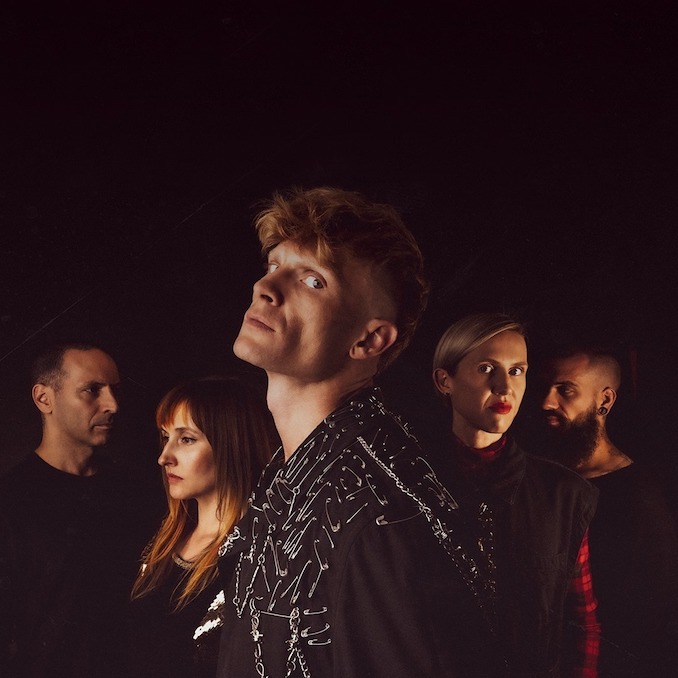
This article originally appeared in The Vancouver Guardian.
In their zeal to keep moving forward and growing, artists often dismiss their earliest work as the product of a half-formed sensibility—the new stuff is what really matters. Ryan Guldemond, on the other hand, says he has a “really healthy relationship” with the songs his band Mother Mother wrote and recorded for its 2008 sophomore LP, O My Heart.
When TikTok influencers latched onto some of those songs last year—specifically “Hayloft”, “Arms Tonite”, and “Wrecking Ball”—Mother Mother’s music went viral. That’s one reason why, despite having a new album called Inside to promote, the band will dig deep into its back catalogue for five back-to-back shows at the Commodore from December 2 to 5. Another reason is that Guldemond still really likes the rambunctious chaos of the songs his younger self wrote.
“Those songs came from out of nowhere, and very unlike Inside, I wasn’t thinking of what they meant,” Guldemond tells the Vancouver Guardian in a Zoom interview. “The words were flying out of the sky and through my creative vessel, and coming out as these wildly quirky, courageous, verbose, abstract songs—and none of it was intentional or premeditated. And so those songs, now that I get to reacquaint with them in this way, are reminding me that great art comes from letting go of yourself and connecting to something bigger somehow and letting that energy flow through you.”
Mother Mother’s latest is a very considered piece of art, and that’s not to its detriment. Inside is a concept album about human resilience set against the backdrop of COVID-19. The pandemic kept Guldemond off the stage for nearly two years, and he’s not taking his return to action for granted.
“I think we’ve always been connected to the lucky gift that it is to be in a band and make it work, and play in front of people and have people want to see you,” he says. “But I think this long hiatus has instilled a new perspective, a new sense of gratitude. So we’re really just awoken to that truth now more than ever.”


Leave a comment