Confession time: I don’t generally enjoy listening to Frank Sinatra. I think it’s because, to my ears, he invariably sounds as if he doesn’t actually believe a word he’s singing. And that makes his occasional half-assed attempts at sincerity feel forced and smarmy.
I will make an exception at Christmas, however, because if I wasn’t willing to put up with a certain degree of forced sincerity and smarminess, I wouldn’t be able to enjoy and Christmas music at all. (And I know many people who don’t.)
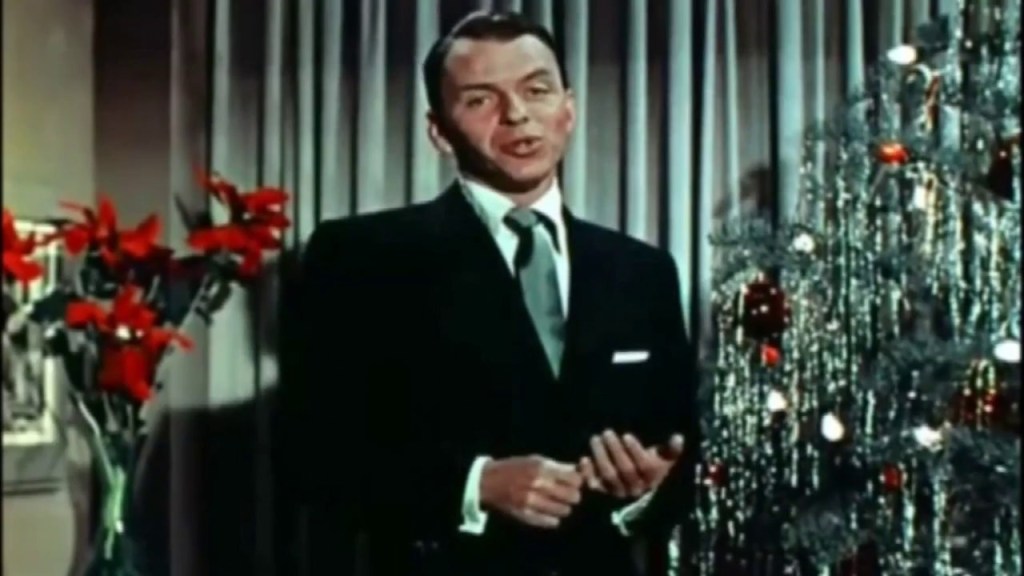
Having said all that, I was very happy to randomly discover a few years ago, on YouTube, a 1957 episode of The Frank Sinatra Show in which Bing Crosby pops by and the two crooners either do a very good job at acting shitfaced or actually are not just pretending to drink wassail. And, let’s face it, this is Bing Crosby we’re talking about, so you just know something was being smoked off-screen.
We have since made an annual tradition of watching “Happy Holidays With Bing and Frank”. I almost had a panic attack one year when it disappeared from YouTube; fortunately, I was able to find it on Vimeo and have since invested in a DVD, just in case.
The show begins as it means to carry on, even before Crosby shows up, with Old Blue Eyes decorating his Christmas tree with candy canes (apparently very sticky ones) and other ornaments, missing the tree altogether at least once, and singing his latest single, “Mistletoe and Holly”, in a way that makes it sound as if his very soul is shrugging.
I’m being slightly facetious, of course. I do actually love this particular piece of pop-culture ephemera unironically, and it’s certainly much less depressing than the Christmas episode of The Judy Garland Show (which we also watch every year against our better judgment).
But in the hell has pheasant for Christmas dinner?
Okay, let’s keep that retro stop-motion vibe going, this time with some local content from Mr. Christmas himself, Michael Bublé. (Well, local to me, anyway; Bublé was born in Burnaby, which borders on my beloved East Vancouver.)
As it turns out, Irving Berlin’s “White Christmas” is the pivotal song in Bublé’s singing career. The story goes that no one in his family even knew he could sing until one fateful car trip when Bublé was 13. Or maybe he was 15; accounts vary. The point is, he began belting out “May your days be merry and bright…” and the rest , as they say, is history.
In 2011, Bublé released his first (and to date, only) Christmas album, the imaginatively titled Christmas. You’ve probably heard of it. We won’t get into specific sales figures (because who actually buys albums anymore?), but Christmas is one of the best-selling LPs of the 21st century and also one of the best-selling Christmas albums of all time. It perennially tops the Billboard Top Holiday Albums chart, and is in fact in the number-one spot on that list as I write these words.
Here’s the video for “White Christmas”, featuring all the classic Rankin/Bass elements, including a living snowperson and pointy-hatted elves assembling toys in Santa’s workshop. Here’s hoping they got paid extra for being in this video.
Fun fact! This was directed by Lior Molcho, who also made the Sia video I posted yesterday.
Welcome to December! Each day until the 25th, I will be posting a festive music video. They will mostly be Christmas-themed, but there are other holidays this month, too, so why not get them all in? (I would carry this on right up to New Year’s Eve, but even I deserve a holiday break, arguably.)
There’s just something about stop-motion animation that evokes that Christmas feeling. And when I say “something”, I of course mean “memories of Rankin/Bass TV specials from the 1960s and ’70s”. I’m talking about Rudolph the Red-Nosed Reindeer, Santa Claus Is Comin’ to Town, and The Year Without a Santa Claus. Yes, they’re dated and corny and quite honestly not all that good, but that’s all part of their charm.
That Rankin/Bass style continues to inspire filmmakers looking to trigger instant nostalgia in sentimental viewers. Think of Leon the Snowman and Mr. Narwhal from Jon Favreau’s Elf, for example.
Pop singer Sia borrowed some of the Rankin/Bass vibe when she tapped Lior Molcho to direct animated videos for some of the songs on her 2017 album Everyday Is Christmas, including the two chapters of “Snowman” and “Candy Cane Lane” (which you can watch below), in which a mischievous living snow creature wreaks all kinds of holiday havoc.
Fun fact: Molcho is an Israeli Jew and Sia is from Australia, where December 25 falls in the middle of the blazing-hot summer. Which just goes to show, I suppose, that the holiday spirit knows no cultural or geographic boundaries.
Here’s what I’ve been up to lately. Mostly writing for Stir, but there are other exciting things in the works.
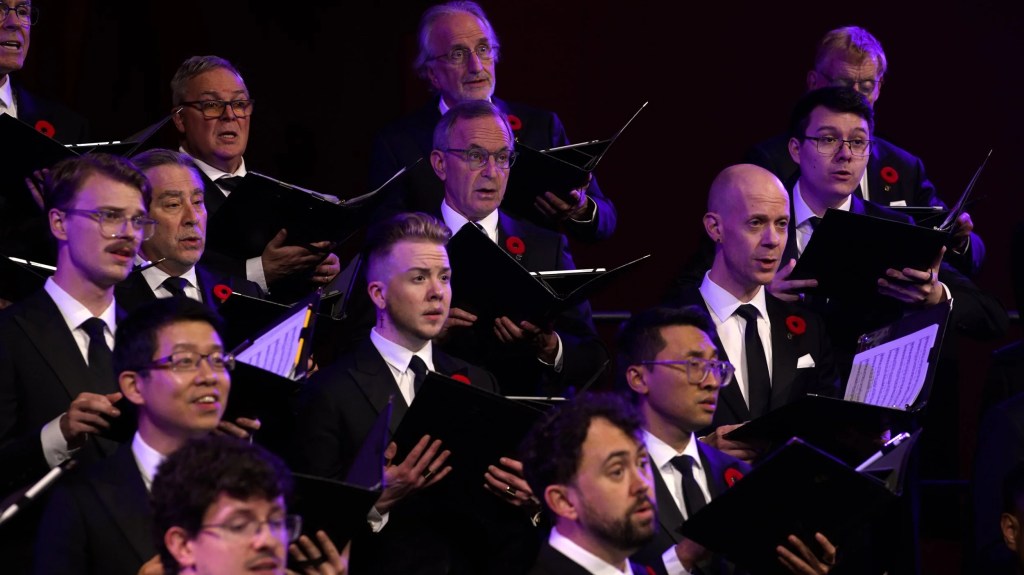
Chor Leoni sings of healing and hope in The Songs Will Remain
(Stir, November 4, 2025)
IT’S NOT OFTEN that a choral performance goes viral, but that’s precisely what happened when Chor Leoni released a video for its version of the Kate Bush song “Army Dreamers”. Recorded live at St. Andrew’s–Wesley United Church, the video captures the Vancouver men’s choir singing Ken Cormier’s arrangement of the song, which poignantly portrays a mother’s anguish over a son lost to an unspecified war: “Should have been a father/But he never even made it to his twenties.”
As of this writing, that video has racked up 1,058,845 views on YouTube.
Chor Leoni’s timing could not have been better. The choir uploaded its video in April 2022; a month later, the fourth season of Stranger Things sparked a resurgence of interest in Bush’s music with the inclusion of “Running Up That Hill”. Then, in 2024, the TikTok generation discovered “Army Dreamers”.
“What is interesting is that this viewership for our video was clearly driven by young people, most completely new to what choral music is,” Chor Leoni artistic director Erick Lichte tells Stir. “So, just hearing a choir sing a song which is trending opened a new listening world for some of these folks…”
Eastside Culture Crawl artists are drawn to wildly divergent approaches to image-making
(Stir, November 14, 2025)
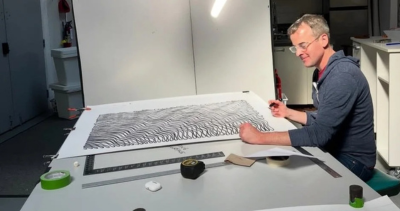
ROGER MAHLER’S DRAWINGS likewise benefit from the perceptions of individual viewers. By design, his work is entirely free of narrative or figurative elements.
While this might seem like a radical departure from the pictures Mahler produces in his day job as a corporate photographer—think C-suite head shots, product photos, and advertising images—he contends that his approach isn’t really all that different.
“In photography, you’ll always take things out to simplify a picture,” Mahler says while giving Stir a tour of the Parker Street Studios space he shares with his wife, business partner, and fellow Culture Crawl exhibiting artist Holly Truchan. “And this is almost a version of that—taking everything out and just dealing with one line and one colour…”
(5440.com, November 20, 2025; commissioned by Divine Industries)
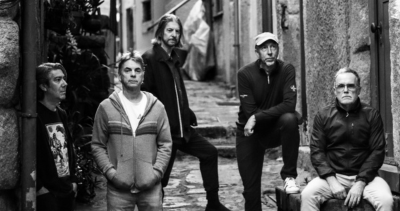
Sometimes a creative endeavour seems to take on a life of its own, with the artist merely acting as the conduit through which the art finds its way into the world. That was the case when 54-40 began to create its 16th studio album, Porto, with producer Warne Livesey. According to singer-guitarist Neil Osborne, everything just sort of clicked into place. “It seemed like it was writing itself, in terms of the whole making of the album,” Osborne recalls.“Everything was very quick and instant and immediate. And maybe that’s based on our experience of learning how to not overthink things, I don’t know, but it just seemed like there was a wind in our sails right from the get-go, from the lyrics to the music to getting Warne on-board to pre-production.”
When it came time to record, the long-running B.C.-based band decamped to the Portuguese city of Porto, from which the new album takes its title. Setting up shop at Arda Recorders for a couple of weeks, Osborne and his bandmates—guitarist Dave Genn, bassist Brad Merritt, drummer Matt Johnson—maintained their forward momentum, in spite of a massive power blackout that took the entire Iberian Peninsula off the grid for a day. “Recording in Porto was an amazing experience,” Merritt says. “The studio and staff were superb. It was nice to be able to make another recording with the great Warne Livesey, and it was a bonding experience that won’t soon be forgotten…”
(Please note that my work begins at the second paragraph on the page linked above; the first paragraph was written by someone else, presumably the band’s publicist. I would also like to take this opportunity to note that writing artist bios is one of the services I offer, and one that I particularly enjoy.)
Chapel Sound’s Notebook Season showcases experimental electronic music from around the world
(November 21, 2025)
ON PAPER, UNDERGROUND club music from the Netherlands might not seem to have that much in common with traditional Arabic instrumentation and Southeast Asian martial arts. To Veron Xio, however, it all hangs together, and in some ways it’s the differences that make it work.
Xio, a Vancouver-based music producer, is the founder of Notebook Platform, an electronic-music and artist-development initiative. In collaboration with other likeminded creatives (including Nancy Lee of Chapel Sound Art Foundation and Mada Phiri of Made By We), Xio curates Notebook Season, which they describe as “a miniature festival of artist talks, workshops, and experimental music performances”.
While the prospect of “experimental music” might seem daunting to some potential audience members, Notebook Season’s mission is not to alienate anyone.
“I think we see experimental as a very loose term in the sense of just, how do we stretch things that we know in ways that we’ve haven’t seen before?” Xio tells Stir in a video call…
The Improv Centre mines classic TV-comedy tropes for yuletide yuks in ’Tis the Sitcom
(Stir, November 18, 2025)
The holiday episode is a TV sitcom staple, and everyone has their personal favourite. For The Improv Centre’s artistic director, Alan Pavlakovic, it’s “Secret Santa”, a 2009 episode of 30 Rock—especially the scene in which Danny (guest star Cheyenne Jackson) intentionally sings off-key to make Jenna feel more confident in her own vocal abilities.
On a joint call with Pavlakovic, Jacki Gunn tells Stir that her perennial pick is “The One With the Holiday Armadillo”, a 2000 episode of Friends. “The moment where Ross is forced to wear an armadillo costume is pretty iconic,” Gunn says.
The Improv Centre is mounting its very own holiday special this year, in the form of’Tis the Sitcom, which lovingly satirizes the sort of TV comedies that focus on groups of friends, roommates, and/or co-workers in urban settings. Think all of the aforementioned shows, plus The Big Bang Theory, How I Met Your Mother, et al...
On this day 15 years ago (November 16, 2010), American indie label capture Tracks released the self-titled debut album by the Soft Moon, which was actually a solo project by L.A.-based musician Luis Vazquez. In 2013, I interviewed Vazquez during my stint as the “Sound Check” columnist for Concrete Skateboarding magazine.
Vazquez and I discussed the making of the second Soft Moon album, Zeros, and he also shared that he had been experiencing recurring dreams about the end of the world since his childhood.
This would be my one and only interview with the Soft Moon. Tragically, Vazquez died in 2024 of an accidental overdose of fentanyl, cocaine, ketamine, and ethanol.
Sound Check: The Soft Moon
Needless to say, the Mayan apocalypse didn’t happen back in December like a few wing nuts predicted it would. If it had, however, Luis Vasquez would have been ready for it. You might say the San Francisco-based musician has been preparing for the end times all his life, albeit not consciously.
“Since I was little, I’ve had over a hundred recurring dreams of the world ending,” says the frontman for The Soft Moon. “And they all end differently every time. It’s pretty crazy. I’m kind of fascinated by it, and every time it happens to me in my dream, I accept it. It’s very overwhelming and scary, but necessary, in the way I feel in the dream. I just sit down, and as it’s happening—as the world’s kind of crumbling—I close my eyes and let it happen. I like to interpret that through my music, so it’s kind of like re-creating my dreams sometimes. I like to create what it looks like in my head through music.”
It probably goes without saying that The Soft Moon’s songs aren’t all sunshine and lollipops. On the project’s most recent long-player, Zeros, Vasquez (who records solo but plays with a full band live) paints the world in 10 shades of black. From the churning industrial noise and motorik pulse of “Machines” to the haunted-man atmospherics of “Insides” and the bass-driven tribal minimalism of “Remembering the Future,” the album is an oddly exhilarating descent into the depths of one man’s end-of-all-things anxiety.
There aren’t a lot of hooks to be found, and it’s pretty much impossible to make out anything Vasquez is singing. He admits that he obscures his vocals on purpose. “I like to treat my voice more as an extra instrument, on top of all the other layers of instrumentation,” he says. “But there’s also another reason. My whole life, I’ve always struggled with words to communicate my feelings. So there’s frustration in that. Thankfully I have music to express myself, but that frustration comes out in my music, where you can’t tell if the vocals are another instrument or if I’m actually singing—I’m either screaming, yelping, or I’m burying my vocals in the mix. And that’s just to represent the frustration I have with communicating through words.”
The Soft Moon invariably garners comparisons to first-wave British post-punk groups, and there’s a good reason for that. Listening to Zeros, it’s hard not to be reminded of the fire-dance intensity of Killing Joke, the encircling gloom of Joy Division, or the claustrophobic moping of 1982’s Pornography by The Cure. Ask Vasquez to name his influences, however, and he’s more likely to list Prince, Slayer, and Duran Duran.
“A lot of the comparisons I get with my music are to bands I never really got into as much, so I always kind of sit back and wonder why I happen to sound like these bands, because I don’t disagree,” he notes. “But it’s weird. It’s almost like there’s this kindred-spirit thing, or like I live in the same world as bands like Bauhaus, or the musicians that were in Joy Division, or things like that.”
Those bands also stuck to the dark side of the street, and found themselves labelled “gothic rock” by the music press of the day, much to their horror. Vasquez doesn’t recoil at the sound of “the G word”, but that might be due to the fact that he’s not sure exactly what it means.
“I don’t know if I’ve ever really met a true goth person,” he says, then quickly reconsiders. “I think I met one, this one guy in Leeds. He proudly considered himself a real goth, and he was a lot older. My stereotype on goths is what I know from high school, and I don’t even know if those are real. You know: they dressed in black and kind of looked like Robert Smith a little bit.”
“I am open to whatever people consider my music, because I don’t know what I’m doing. honestly,” Vasquez concludes. “So if people out there know what it’s called, then they can call it whatever it’s called.”
With Nelly Furtado’s recent announcement that she will be retiring from live performance “for the foreseeable future”, it seemed timely to repost these two interviews I did with her for the Georgia Straight back in the day.
THE NELLY FURTADO who gazes out from the cover of Inside Entertainment‘s April issue looks calm but intense. Her dark-brown hair is frozen in the grip of some impossibly perfect indoor breeze, and the strap of her red Nicole Miller cocktail dress hangs off a bare shoulder. Ice-blue eyes peer from below pink-frosted lids, and Furtado’s golden skin appears Barbie-doll smooth.
When the Georgia Straight shows the singer the magazine, she says she remembers doing the shoot some months ago but admits that she hasn’t seen the cover yet. When she does, her bemused reaction carries an undertone of familiar resignation. “Wow,” she says, casting an eye at the photo. “That doesn’t even look like me.” By this point, three albums into her career as a global pop sensation, the Victoria-born and now Toronto-based single mom has grown accustomed to the digital manipulation of her features, but it still has the power to surprise her by pointing out her supposed deficiencies. “I didn’t know there was something wrong with my nose until I saw it retouched,” she says.
Sitting for interviews at a downtown Vancouver hotel, the 27-year-old Furtado looks positively radiant, ever-so-slightly asymmetrical nose and all. That’s worth noting, because whether she likes it or not, her image is the centre of much discussion at the moment. This is hardly a recent development; Furtado herself addressed the topic on her 2003 song “Powerless (Say What You Want)”, in which the performer, who is of Portuguese descent, sings “Paint my face in your magazines/Make it look whiter than it seems/Paint me over with your dreams/Shove away my ethnicity”.
What has tongues wagging these days is sex. First there was the interview with European gay-lifestyle magazine GUS, in which Furtado said she believes all people are inherently bisexual. People have also been abuzz about the sexually frank lyrics on Furtado’s recently released third CD, Loose, not to mention the midriff-baring libertine she seems to have become, if the video for the hit single “Promiscuous” is any indication. “After I had a baby, my body changed a lot,” Furtado says by way of explanation. “I got more curvy and felt more like a woman, and I think I’m just more proud of my body now. I think I’m a late bloomer. You know, I was a tomboy for a while, and I kind of all of a sudden went, ‘Wow.’ I started celebrating my femininity a little bit more.”
Recorded in Miami with Tim “Timbaland” Mosley cowriting and producing most of its tracks, Loose is a heavily beat-driven outlet for that celebration. The aforementioned “Promiscuous” is a hot-blooded hip-hop duet between a flirtatious Furtado and Mosley, while the thumping, synth-tastic new wave of “Maneater” scans like the female-perspective answer to the old Hall & Oates number. The latter song finds Furtado encouraging the listener to “move your body around like a nympho”, which goes a long way toward explaining why Rolling Stone opined that the singer has gotten in touch with her “inner slut”. That’s a charge Furtado denies, but she does acknowledge that in marked contrast to her comparatively more cerebral last record, Folklore, Loose is all about the body, not the mind.
“I really think something happened to me in Miami when I was down there,” she states. “It’s a really sexy city. I’m like a sponge. I kind of become my environment sometimes. That’s the way I experience life.”
Furtado insists that her apparent transformation into a libidinous reveller is not a self-conscious attempt at changing her image. Rather, she says it’s merely a revelation of a hitherto-unexplored aspect of a complex whole. “I like the idea of the funny, sexy, and smart woman; the three-dimensional sort of thing,” she says. “I think more than anything, more than the clothing, it’s my attitude that people are noticing, because I’m a lot more confident as a performer, and I think I’m able to express myself more completely on-stage and in my TV performances and my videos. So I think that’s what’s really turning heads.”
The singer credits her producer’s unpremeditated approach to music-making with giving her the confidence to trust her instincts. “The way Timbaland makes music is he makes it from the gut,” she reveals. “He’s really impulsive, and he dances while he makes beats. His body’s always moving, and so I had no choice but to jump right in and let go of thinking and follow my impulses too. So it’s a much more impulsive album; it’s much more raw. It comes from the gut. It has musical errors. That was important for me, and that’s why I called it Loose, because I wanted it to be reality audio. Now that reality TV’s so popular. I wanted to make it less precious. And that came from listening to rock music, like indie rock.”
Furtado gives particular kudos to Controller.Controller and Death From Above 1979, two Toronto acts that take a visceral, eminently danceable approach to their post-punk aesthetic. Furtado caught a double bill of these bands and was impressed. “I noticed how sexually assertive the singers were on-stage, and I got influenced by that. One person described it as like a ‘sexual menacing’, and I think some of the songs [on Loose] have that weight to them.”
Loose never comes close to Controller.Controller’s brand of indie death-disco, but the disc offers a slice of percussive reggaeton (the Spanish-language “No Hay Igual”), a dash of sparkling Latin pop (“Te Busque”, featuring Colombian superstar Juanes), and a slather of sunset-rubdown R&B (“Showtime”). “I’m a person who listens to all kinds of music, and I channel it into my own music in a way where you can’t even hear the influence at the end of the day,” Furtado says. “I guess it’s like a computer: you just kind of input information and then you process it your own way.”
The results of that processing have met with generally favourable reviews, although a few dissenting critics have noted that the one thing that seems to be absent from the new album, with all its floor-filling beats and genre-splicing hedonism, is Furtado herself. E! Online said that on Loose, Furtado “mysteriously trims away her individuality and morphs into a J.Lo imitator”. Vibe accused the artist of losing herself in “Gwen Stefani–like posturing”, while Pitchfork stated that “the strangest thing about Loose isn’t its irregularity, but the simple fact that this doesn’t sound like Nelly Furtado at all.”
The singer deftly sidesteps the question of where exactly her identity can be found on the album, but she is quick to point out that elements of R&B, dance music, and especially hip-hop have been present in her work since even before her debut CD, Whoa, Nelly!, came out in 2000. “I think the thread that holds this album together, and holds my musical history together, is the technology thread,” she says. “I really love urban music, whether it’s hip-hop or electronic trance, drum ‘n’ bass, or whatever it is. I like it all, and I’ve dabbled in all of it. My first recording gig was for a hip-hop group [Plains of Fascination] when I was 16, and then I did the trip-hop thing for a year when I was 17, and then I jammed with a techno DJ from Victoria called Matt Johnson. We used to jam together when I was going to college. I would even dabble on the keyboards and drum machines. Even when I was eight years old, I was asking my parents for Casio keyboards so I could jam.”
Anyhow, naysayers be damned: Loose is a hit. As of this writing, the record holds the No. 4 spot on Billboard‘s album rankings, with “Promiscuous” sitting atop the same publication’s Hot 100 singles chart. Locally, Loose is No. 1 on the Straight‘s own Top 50. All of which must seem like vindication for Furtado. Prior to the new disc’s release, she was an artist with something to prove. Whoa, Nelly! was a Grammy-winning, six-times-platinum success story, but its follow-up, Folklore, was a commercial letdown, thanks to a complex web of bad timing. It could be argued that the CD–buying masses simply didn’t know what to make of the serious-minded record, which addressed themes of cultural identity and boasted performances from such decidedly non-pop guests as Bela Fleck, Caetano Veloso, and the Kronos Quartet. Moreover, Folklore was released right as Furtado’s then-label, DreamWorks, was collapsing, which meant the album didn’t get the push it warranted. A new mom at the time, Furtado couldn’t tour much in support of Folkore, which didn’t help matters. The disc sold well and charted respectably, cracking the Top 40 in both the U.S. and Canada, but it failed to attain the dizzying heights of its predecessor.
For that reason, Furtado was determined to stage her return to the spotlight with an unashamedly populist, world-conquering effort. “I have a bit of that fighting spirit,” she admits. “I think Timbaland brought that out in me more than anybody, because he’s such a good producer, and he really pushes you as an artist. You always feel like he’s throwing you a fastball and you have to hit a home run. He’s the one producer who truly makes me feel challenged on every level as a musician, as an artist, and conceptually too. He kind of challenges me to think in a more universal way about what pop music is and what it means to people. I think, just elementally, he brings out my more passionate and powerful side of myself as an artist. So I think he aided in giving me that kick-ass mentality.”
Then, of course, there was the matter of making sure the suits were satisfied. Furtado claims she received more encouragement than pressure from the overseers at Interscope, which owns Geffen, the label she records for.
“They were challenging me a lot,” she says. “They were pushing me in a positive way, the label. Jimmy Iovine, the president of Interscope, said, ‘You know, you and Timbaland made a promise to people when you put out that “Get Ur Freak On” remix [a 2001 collaboration with Missy Elliott]. You have that urban side of you that you’ve never explored. You’ve only given people a taste of it, so I think it’s time for you to deliver on that promise.’ And that’s what I did.”
Indeed she did. And that’s a good thing, even if it does mean that Furtado will have to look at barely recognizable reconstructions of herself for some time to come.
NELLY FURTADO DIVIDES her time between Toronto and Miami these days, but she’ll always be a West Coast girl at heart. Furtado was born and raised in Victoria, which is where she’s set to kick off a Canadian tour this week, the night before she hits Vancouver.
Such is the esteem our provincial capital has for the singer that in 2007, the city declared March 21 to be Nelly Furtado Day. She will surely feel the love when she steps on-stage at the Save-on-Foods Memorial Centre, but that doesn’t mean Furtado won’t also feel a little extra pressure.
Nelly Furtado divides her time between Toronto and Miami these days, but she’ll always be a West Coast girl at heart. Furtado was born and raised in Victoria, which is where she’s set to kick off a Canadian tour this week, the night before she hits Vancouver. Such is the esteem our provincial capital has for the singer that in 2007, the city declared March 21 to be Nelly Furtado Day. She will surely feel the love when she steps on-stage at the Save-on-Foods Memorial Centre, but that doesn’t mean Furtado won’t also feel a little extra pressure.
“It’s a little nerve-wracking,” she admits when she connects with the Straight during a break in tour rehearsals in T.O. “I find it really hard to play a show in front of my parents, for some reason. It’s not a racy show by any means. It’s just, you want to do your best, don’t you? Even as an adult you want to make your parents proud.”
The last time Furtado played a concert in her hometown was during the tour in support of Loose. That album came out in 2006, and the singer admits she has mostly been “off the pop radar” since then. “I think I was craving some time out of the spotlight, because I’d kind of been at it for a while,” she says. “You know, my first album came out in 2000. Then, at the end of Loose, it was like, ‘Whoa, I’ve been doing this for a while. Maybe I should take a break.’ And I took some time off, did some passion projects, started my own independent label, Nelstar Records, had some fun signing a band [Fritz Helder & the Phantoms], and then putting my Spanish album out on Nelstar, which was really cool—just having complete creative freedom that you can only have when you’re completely independent—and then signing the artist that’s opening for me on this tour, Dylan Murray, and working on his album.…All that stuff took a lot of time. And I didn’t have an interest in recording in English, either, which is probably the most important point.”
Instead, Furtado made that aforementioned Spanish-language album, Mi Plan, and toured the Latin world. Needless to say, however, she felt compelled to sing in English again, with the result being her latest LP, The Spirit Indestructible. As exemplified by singles such as “Big Hoops (Bigger the Better)” and “Waiting for the Night”, the album is largely characterized by exuberant dance-floor beats wrapped around pop melodies. Like much of The Spirit Indestructible, those tracks were cowritten and produced by Rodney “Darkchild” Jerkins.
“Every time we were in the studio it felt like we were kids in the sandbox,” Furtado notes—and it didn’t hurt that she was working with the man who helped make major hits for the likes of Aaliyah, Mary J. Blige, and Brandy back in the ’90s.
“He produced a lot of the music that I was really into as a young teenager, and I think that’s why there’s a nostalgia vibe when you hear the album,” Furtado says. “I was kind of living out my 14-year-old dreams working with him in the studio. It was just a really heightened, inspired time that we shared together in the studio. It’s so precious, as a songwriter, when you can feel that inspired and passionate. It’s such a wonderful thing. It’s just so rare. You can’t really plan for that.”
Because you, the reader, demanded it, here’s the rest of the story.
PART 5
The next morning Derf did just that. The man from the tavern let Derf in.
“Last night you said something about knowing of the dragon?” Derf didn’t waste any time in asking.
“Yes, ride with me today and I’ll show him to you.” He reached out a hand to Derf, who took it, though he wasn’t in the habit of shaking hands with strangers. “My name is Randall, I am a mercenary. Right now I am working as a guide. There hasn’t been a war worthy of note in over two years, so I don’t have much more to do.”
“My name is Derf. I am on a mission for the Ring Council of Ballarnick. I am to slay the dragon and obtain the Sword of Nagrad.”
Randall led Derf through the town. It was a small town, with most buildings made of wood from the surrounding forest. It was an hour’s ride to where they were going, Randall had said.
Derf was surprised when his guide stopped, apparently in the middle of nowhere.
“We’re here,” Randall said, dismounting.
“We’re where? I don’t see anything.”
“Through there.” Randall pointed through the trees into a clearing. There was a small stone bunker. Guarding it was a large, well-muscled man wearing nothing but a loincloth. He had long dark hair and warpaint of many colours covered his face. He held a warhammer and a sword was sheathed at his waist.
“A barbarian,” Derf observed. “Don’t tell me the dragon’s contained in that stone hut he’s in front of.”
“No, that is the Dragon.”
“Huh?’”
“Dragon, that’s his name.”
“Ha ha ha ha, I don’t believe it! I’m a Master Bowman! I can take him out easy!”
Randall wasn’t laughing. “I don’t think so.”
“Hey, I’m not such a bad shot! Well…so I’m not so good either—but he’s such a big target, how could I miss?”
“You don’t understand…” Randall tried to explain, but Derf wasn’t paying attention. He already had his bow and an arrow ready to fire.
Randall gave up. “Go ahead—but be ready to defend yourself when it doesn’t work.”
He doesn’t know about my special arrows, Derf thought smugly. He let the arrow fly, and it hit its mark. It flew straight at Dragon’s chest and exploded. Derf grinned, but his glee soon ended when the smoke cleared and Dragon was still standing. Blood leaked from a small gash on the right side of his chest. He was fuming, his head turning from side to side as he frantically searched for his attacker.
Derf panicked as the barbarian’s eyes fell upon him. “Aah! He’s seen us! We’re doomed!” He rummaged quickly through his saddlebags, searching for a weapon that might be useful.
“Uh, Ring of Truth, no good, Djinni, maybe—no, probably won’t help, takes too long…”
Randall drew his sword. The Dragon caught this movement and hurled his warhammer. Randall tried to dive out of the way but wasn’t fast enough. The hammer smacked him in the head and he fell back against a tree.
By this time, Derf had found what he was looking for: the dagger.
He ran forward with it and made a stab at Dragon, who blocked the dagger with his forearm. It should have stuck in his arm, but it didn’t even pierce his flesh. Which meant, Derf realized, that his skin was tougher than any armour.
With the same arm that had blocked the dagger, Dragon swung out and backfisted Derf with enough power to knock the young archer to the ground.
Derf quickly scrambled to his feet and backed up to gather his wits. Dragon put one hand on the hilt of his sword and, holding the scabbard in the other, drew out his weapon. There was a strange, greenish glow about the blade. It seemed not to stay in place, but rather slither about, like a snake.
Derf backed off to where Randall was. Randall was sprawled out on the ground. He was not moving. Derf picked up his sword and assumed the swordfighting position Jarn had taught him. Dragon advanced and made a downward slash, which Derf blocked. As their swords connected, Derf felt a surge of pain and shock rush through his body.
He remained conscious as he hit the ground. Dragon was above him rearing back for the finishing blow. He realized he was still holding the sword, which had become quite hot.
Dragon swung his sword back over his head, revealing the spot where the explosive golden arrow had breached his skin.
Derf saw his only chance. Utilizing what little energy he had, he thrust his blade into the barbarian’s chest with a violent burst of motion. Dragon slumped over the blade, dropping his own strange sword as he fell.
PART 6
When Derf came to, he felt weak, and his hand was burnt from his sword. Randall had also regained consciousness but had a bleeding head and had lost enough blood to be seriously weakened. He was also very.dazed and confused.
After Randall’s head had been bandaged, Derf decided to take a look around. Dragon’s sword still lay where he had dropped it. Derf picked it up by the hilt, careful not to touch the blade.
“This must be it,” he remarked, “the Sword of Nagrad.”
“Not from what I heard,” called Randall from behind him.
“Oh no?”
“No. Keep looking. Try the bunker.”
Derf sheathed the sword and put it down. He walked through the open door of the bunker. There was only one small room; its single feature was a pedestal in the centre. On the pedestal was an amulet on a golden chain. The amulet was also golden, and in the shape of a sword.
“Now I know this is it.” He picked it up, and put it around his neck.
“Randall! I’ve found it! It’s not a real sword at all!” He walked out of the little hut and over to where Randall sat.
“I feel stronger…it’s strange. Here, I think you need it more than I do right now.” He handed the Sword to Randall.
“Now I have something to do.” He got the shovel from one of his saddlebags and dug a grave for the Dragon.
PART 7
When they had reached Mepinto City again, the Sword of Nagrad had healed Randall to the point that the bandage could be removed. It was here that the two parted ways.
Two days later Derf arrived back in Ballarnick to a hero’s welcome. After the fanfare of his return had subsided, Gennan called him into his chambers for a private meeting.
“I know you probably have many questions. Let me answer them all for you now. Long ago, a man named Nagrad was exploring caves in the easternmost part of Ballarnick. He found some unusual things in one cave, with no explanation of how they got there. The things he found were, of course, the three Rings and the Sword of Nagrad. These items were found to be of great power, so a council was set up to govern their use. But a certain faction decided that they wanted power for themselves, so they stole the Sword and fled. They became nomadic, travelling, and destroyed everywhere they went. We couldn’t stop them because we couldn’t locate them. Until a few months ago. Dragon was one of the last, and he was guarding the Sword.”
“Forgive me for interrupting, but Dragon? One of us? He was a barbarian!”
“You must remember, generations have passed since the Nomads broke off from us, and Dragon was of the new generation. The last generation. Anyway, I believe we have a celebration to get to…?”
EPILOGUE
Derf became the most celebrated hero in the history of Ballarnick. He served in the renamed Council of Power for 8 years. When Gennan passed away, Derf was unanimously voted leader of Ballarnick.
Well! That was quite a journey. My 15-year-old self had quite an imagination. However, I do have a few questions I would ask him if I could:
Why couldn’t the Council just tell Derf exactly what he was looking for instead of sending him to blindly fumble around?
If this was such an important quest, why leave it to an unproven young archer? And why send him by himself?
How and when did Derf get the dagger back from the demi-goblin? And why did it suddenly become a sword during his fight with Dragon?
If Randall was a mercenary working as a guide to eke out a living between wars, why didn’t he charge Derf a fee for taking him to his destination?
How did Randall know so much about the Sword of Nagrad, including its exact location and who was guarding it? Why didn’t he simply use this knowledge to take it for himself?
Have I missed any inconsistencies or plot holes? Tell me in the comments!
I recently came across a fantasy story I wrote back when I was 15. It was in an envelope full of youthful ephemera that my mother gave me a while ago, but which I evidently never looked at. To be totally honest, I didn’t even remember writing this story.
I make no claims that this is a brilliant work of fiction. In fact, its plot holes raise questions. Many questions. But I’ll save those for after I post the second installment. I just thought this long-lost piece of my writerly past was amusing. Perhaps you will also think so.
PART 1
“Journey to Mepinto, slay the dragon and return to Bctllarnick with the Sword of Nagrad.” That was Derf’s quest and he was only too happy to carry it out. At least that’s what he told the Ring Council of Ballarnick. No one ever let the Ring Council down. After all, they were in charge of the Rings. Nobody outside the Council really knew what the Rings were, but were assured by Gennan, the wizened old leader of the city-state Ballarnick that “you better not ask.” Nobody asked.
Derf never asked, either. If he had, he might know what he was after. The Sword of Nagrad was sort of like the Rings. If you don’t already know, don’t ask.
At least Derf knew where he was going. Mepinto was a heavily forested land just north of Ballarnick. He had never heard of any dragons there, but with all the animals in that area it was hard to keep track.
Derf, once a mere apprentice archer, had recently graduated to the rank of Master Bowman. It hadn’t been easy, but he was undaunted. He struggled and finally made it to the top. But he was still unproven. Sure, he had been on plenty of missions with his tutor, Jarn, but the council decided for Jarn to fully earn his rank, it was necessary to send him on a quest of his own.
PART 2
Derf set out on his quest early in the morning. The Council, Elders, Gennan, Jarn and other city dwellers gathered at the gates of Ballarnick to see Derf off.
After a short ceremony in which Derf was presented with his equipment and his mount, the short, blond, blue-clad archer made his farewells and rode off.
Derf felt good as he rode towards the mountains on his white horse, Varado. His confidence was growing. He felt heroic.·
It was a day’s ride through Kantir Valley before he reached the outskirts of Mepinto. The Kantir Valley was home to some reputedly unfriendly tribes of demi-goblins. Derf entered the valley cautiously, looking around. Through the middle of the valley ran the Grush River, which was in fact no more than a creek. The valley was twenty feet across at its narrowest and two hundred at its widest. On each side the ground rose up into great hills of dirt and rock, with a few sparse trees.
Derf made sure to keep an eye out for caves. From high in the hills came frightening whoops. Derf’s new-found confidence slowly turned into fear. And then into terror when a demi-goblin stepped out from a niche in the craggy wall.
The young archer’s teeth chattered uncontrollably. This was the first demi-goblin he had ever seen. It was the size of a large man, but its face was hideous by human standards. Its eyes were small and close together under its large brow. Its nose was a snout, which flared when the beast breathed.
It was walking toward Derf. The archer slowed his horse down and waited for the monster to approach.
“Um…hello!” he ventured. “I’m just passing through your, uh, pleasant little valley here.”
The demi-goblin raised a hand in the air. I wonder if that’s a greeting, thought Derf. It soon became obvious that it wasn’t, as a horde of whooping demi-goblins came down from the hills.
“Oooo-aah! Oooo-aah!” they cried. Derf’s horse reared up on its hind legs, almost knocking off its rider. They were now surrounded. Some of the demi-goblins held spears, others had clubs. One, who was dressed in a red cape, yellow tunic, and leather sandals, waded through the crowd to Derf.
“You.” Derf was surprised to hear it speak. “You would pass through Kantir?”
“Yes.”
“Then you must pay toll.” Now Derf understood why he was so well-dressed.
“How much do you want?” The council had supplied him with two thousand capits, but Derf was not about to give all of it up.
The demi-goblin put a hand on his chin and had a thinking expression on his face. “Hmm…five thousand.”
Derf felt a lump in his throat. To come close to five thousand he’d have to give up Varado and his equipment. He thought of fleeing, but there was nowhere to go.
“Well, uh, I was sort of thinking in the neighbourhood of say, er, three hundred?” Sweat dripped down his forehead.
“I make no deals,” the goblin replied.
“Well, you see, I doooooon’t quite have that much.” Derf was running out of ideas.
“Let me see what you have,” the demi-goblin demanded.
Derf dismounted. He wasn’t sure exactly what he had, as Jarn had slipped some items in his saddlebags at the last moment without explanation. He unlatched one saddlebag and unloaded its contents. A rope, a tinder box, candles, herbs, and a sack of gold. The goblin wanted only the gold.
Derf opened the next bag. This is where Jarn had put the last-minute items. There was a small pearl-handled dagger in a leather scabbard. This the demi-goblin took. Next out of the bag came a small dark bottle.
“What’s in it?” questioned the goblin, grabbing it.
“I…I honestly don’t know.”
“Bah!” The half-human flung the bottle to the ground impatiently. Incredibly, it remained intact. Derf picked it up and studied it.
“There’s an inscription on it. I can’t quite make it out.” He rubbed the dirt off where the words were and the cork popped out. Green smoke poured out of the bottle, clouding the large group of demi-goblins for a moment. Then, the smoke all rushed together, and, in a burst of light, formed the figure of a woman. Her features were somewhat undefined, but it was clearly a woman. Derf’s jaw dropped.
“Wha… Huh?”
“I am Hendrin,” the figure spoke. “Your Djinni. What do you desire?”
It took a while to sink in, but Derf realized the advantage he was at. So did the demi-goblin leader. An expression of sheer hopelessness formed on his ugly face. A grin slowly spread across Derf’s.
Needless to say, the rest of Derf’s travel through the valley was uneventful.
PART 3
When Derf finally reached Mepinto it was dark. He rode into a forest and set up camp in a clearing. He fed Varado and started a fire. Being too tired to hunt, he ate some of the provisions supplied for him. He realized he would probably have quite a day ahead of him, so he turned in early.
Before he was ready to leave the next morning, Derf had one thing to do.
His curiosity got the best of him. He had to find out what Jarn had put in that saddlebag. While he was laying the items out before himself, Derf noticed something else in the bag. A scroll. He unrolled it. It was from Jarn, and this is what it said:
Derf, my former pupil and present peer, I wish you luck on this, the most important journey of your life. I have provided a few articles which might help you in some way.
Dagger—which pierces any armour.
Six golden arrows—these arrows explode on impact.
Djinni—will grant many wishes, but will not do what you must do alone.
Ring of Truth—will cause the wearer to respond truthfully to any question.
I have a final word of warning for you. Do not be deceived. The Dragon is not as ominous as he sounds, but is far deadlier than he seems.
We all wish for your safe return,
Jarn
After riding awhile that day, Derf got hungry and decided to hunt for rabbit, which there certainly were plenty of. Spotting a likely candidate, he quickly took aim and let fly with an arrow, which missed.
“Moved,” the Master Bowman grumbled. He decided to get it on the run so he fired another arrow in the same direction.
THUNK!
“Thunk? Weird, but I hit it.” Derf walked toward his lunch and stopped in his tracks.
“A stump? I’ve been shooting a stump? Aaaaaaaarggh!?!” He took another arrow and fired it into the stump. Old wood and dirt erupted in a powerful explosion.
Derf stood back and admired his handiwork.
“Shouldn’t have done that, I don’t have a lot of those arrows,” he sighed. “But it sure was fun, heh heh heh.”
PART 4
Derf reached Mepinto City by early evening, a few hours before the sun went down. He got a room and a stable for his horse at an inn, the Wily Coyote.
After settling into his room, he went downstairs to the tavern.
A fight was in progress. A hairy man in black was beating a green-clad man over the head with the leg of a table. Others joined in, tackling and hitting each other for no apparent reason.
The barman called out, “Bouncer!”
Hearing this word, the participants of the brawl stopped their pummeling and stood like statues. A creaking of floor-boards in the next room sent them scrambling for the door, climbing all over each other to get out.
This must be some bouncer, thought Derf. He wasn’t disappointed.
Into the room strolled the largest woman Derf had ever seen. She was at least 6’2” and covered head to toe in muscle. She wore a small amount of armour.
“You wanted something?” She addressed the barman.
“Not anymore. Go ahead with whatever it is you’re doing back there. What are you doing, by the way?”
“You don’t want to know.” She turned and walked into the back room.
Derf ordered a meal and when he had finished, started asking questions about the dragon. Either no one knew, or they just weren’t telling. Derf gave up. He considered using the Ring of Truth but to do so might mean dealing with the bouncer. That he didn’t need. He headed for the stairs when a man in a leather coat stopped him.
“I know of the Dragon,” he whispered. “Come to Room 1 at dawn tomorrow.”
On this day 16 years ago, the Georgia Straight published my interview with Dinosaur Jr.’s Lou Barlow. I must have caught Barlow on a good day, because I found him to be quite gregarious. This is in marked contrast to the experience of fellow Straight contributor Shawn Conner, who had interviewed the bassist two years earlier and found him to be “cantankerous”. Barlow gave me some pretty funny quotes about what it’s like to be in a band with J Mascis and Murph.
For most of its initial run, from 1984 to 1997, Dinosaur Jr. was essentially a one-man show, and that man was J Mascis. After giving founding bassist Lou Barlow the boot in ’89, Mascis took the creative reins, getting his unique combination of pained-slacker drawl and often jaw-dropping six-string pyrotechnics down to a science.
Since the original Dinosaur Jr. lineup—which also includes drummer Murph—reconvened in 2005, Barlow has steadily made inroads in the writing department, contributing two songs to both 2007’s Beyond and this year’s Farm. For the latter, the bassist wrote and sang both the psych-rock stomper “Your Weather” and the searing “Imagination Blind”. Each is a worthy addition to the Dinosaur Jr. catalogue, but neither came easily.
Reached at a tour stop in Houston, Texas, Barlow explains that his preferred way of making music, organically and collectively, is at odds with how his bandmates tend to operate. The meticulous Mascis usually presents his colleagues with demos of songs that are already fully composed, right down to the drum beats.
“I don’t think either of them are really that interested in collaborating, because Murph is so in the zone of having J tell him what to do, and J is difficult to engage,” says Barlow, who spent his non-Dinosaur years leading iconic indie acts such as Sebadoh and Folk Implosion. “It’s really funny. It’s just another set of personalities and another situation to juggle. I’ve done it with many people, and everybody’s different. Everybody has a different way of working, and J and Murph are no exception.”
The bassist will allow that working with the notoriously obstinate Mascis is considerably easier now than in the ’80s, when it was, he says, “a mind fuck, to say the least”. Dinosaur Jr.’s longhaired frontman might not be quite as passive-aggressive as he once was, but the creative process is still evidently a challenge. However, Barlow notes that when it comes to getting Mascis and Murph onboard for his own songs, the effort is invariably worth it. “I’m always really pleased with what I get out of them in the end. I’m just like, ‘Oh, cool.’
“That’s the kind of thing that keeps me interested in the band,” he continues. “For as much as we’ve done, and as much progress as we’ve made, I still think there’s a lot of potential. And I still feel like I have a lot to learn about how to communicate with them. I have a lot of room to grow, and a lot of confidence that I can acquire to be able to engage them.”
One key lesson Barlow has learned is that a bit of gentle—very gentle—insistence goes a long way where his delicate cohorts are concerned.
“They both are very sensitive,” he remarks. “You can’t really push them at all or they just retreat. There’s this very careful balance. They’re like cats, they really are. Seriously—you can’t make sudden movements or they’ll just run under the bed.”
I guess I’m making this a monthly thing? In any case, here’s a roundup of some of the writing I have done recently, including freelance pieces and a couple of things I wrote just for fun.
Music review: Mad Professor brought earth-shaking dub bass to the Chan Centre
(Stir, October 6, 2025)
The Massive Attack songs were certainly plentiful; Fraser started his set with “Eternal Feedback”, his reworking of “Sly”, the track that kicked off his association with the Bristol trip-hop pioneers. Working with a setup that included a mixer and effects that included copiously applied delay and reverb, he also peppered the show with other No Protection cuts, notably “Trinity Dub” (based on “Three”), “Bumper Ball Dub” (“Karmacoma”), and, of course, “Radiation Ruling the Nation” (“Protection”).
For good measure, Fraser also threw in “Teardrop”, taken from Massive Attack’s 1998 masterpiece, Mezzanine. With Elizabeth Fraser’s powerfully ethereal vocals filling the Chan, Mad Professor brought the song’s signature harpsichord motif in and out of the mix, at one point changing the song’s key entirely with a melodramatic wave of synthesizer before bringing things full circle.
This wasn’t a Massive Attack concert, however, and the proceedings arguably got even more interesting when Mad Professor returned to his roots.
Bilingual Montreal band Bibi Club prefers to perform without a safety net
(Stir, October 16, 2025)
Based around Trottier-Rivard’s unassumingly melodic vocals and Basque’s guitar work, which sometimes takes things into left field with unexpected chord voicings and occasional dissonance, Bibi Club’s music draws on the traditions of indie-rock forebears including Blonde Redhead, My Bloody Valentine, and Stereolab.
That last band looms especially large in the Montreal duo’s pantheon of influences; Bibi Club even recorded its own version of Stereolab’s “Orgiastic” for the extended edition of Feu de garde.
“Stereolab inspired me when I was younger, because I think it was the first time I was listening to a female voice that honest,” Trottier-Rivard says. “It really spoke to me, the way the singer [Lætitia Sadier] sings, and it was the first time I would listen to someone sing in French the way she does, and it really inspired me. I think it kind of helped me to write in French and try to find the right words to make me comfortable, and just to find my style in writing. So that band in that way really inspired me.”
The 10 most spooktacular Halloween music videos of all time
(Medium, October 17, 2025)
In the tradition that I started at the Georgia Straight (which I am sad to report no one has kept up in my absence), here are some Halloween-appropriate music videos. Are they really the “most spooktacular” of all time? Almost certainly not, but for SEO purposes, sure. And even though these are in no particular order, let’s count them down from 10 to 1, just for fun.
Please note that there is no Michael Jackson or Backstreet Boys or “Ghostbusters” on this list. Not because those videos aren’t great in their own right, but because they are just a little too obvious. And you know where to find them if you absolutely must.
Earlier this month, I shared my list of the Top 10 most spooktacular Halloween music videos (which was actually a completely arbitrary selection of things that I happen to like). Because not all things Halloween are equal, this time around I’m bringing you the most horrifyingly awful songs of the season. Because you, dear reader, deserve only the worst.
Occasionally, someone creates a work of art so stupefyingly bad that its very wretchedness provides a high degree of entertainment value. On the other hand, some things just suck. It’s all in the eye—or in this case, the ear—of the beholder.